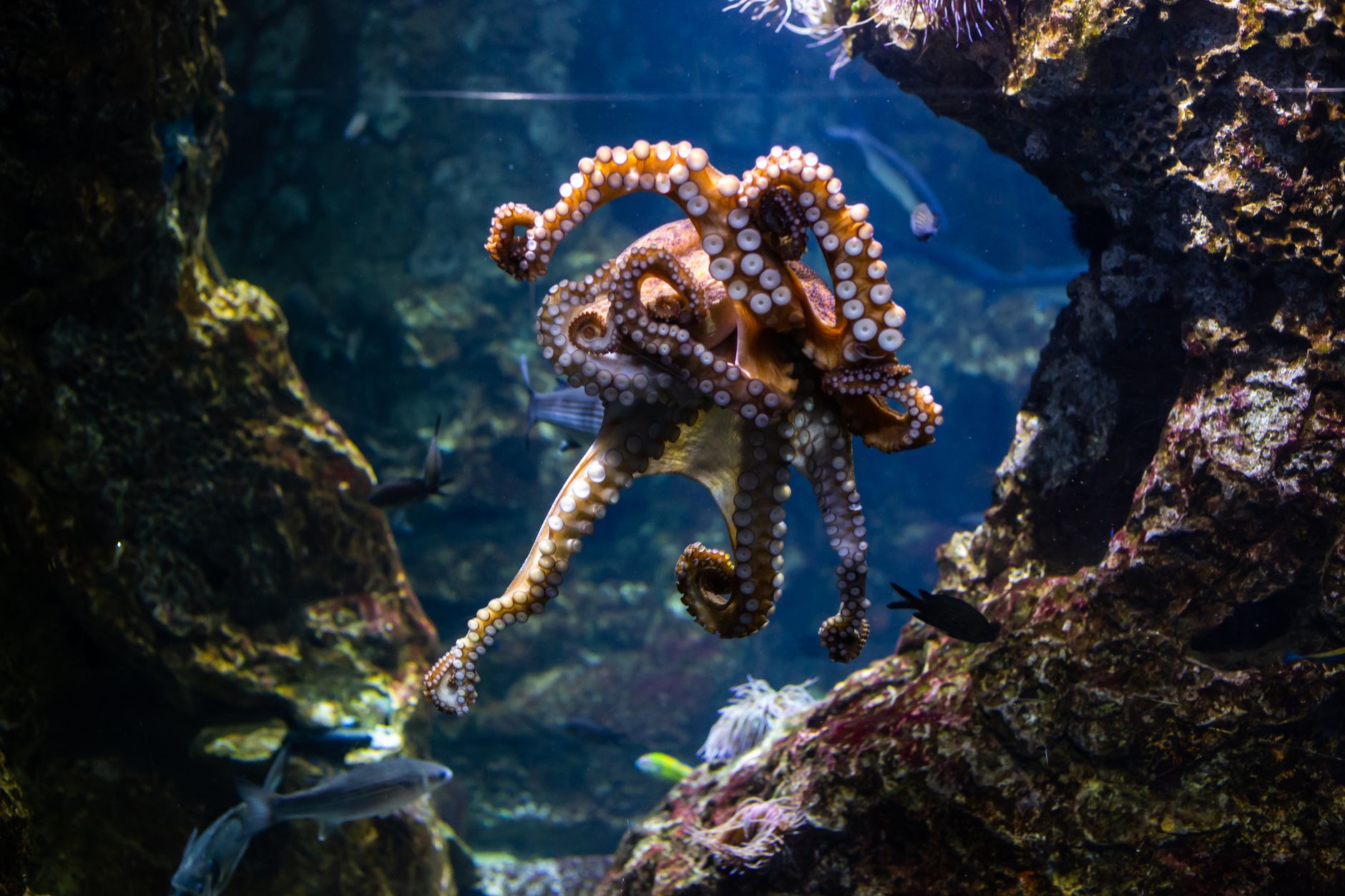
An octopus doesn't think the way you do. Two-thirds of its neurons exist not in its central brain, but distributed throughout its eight arms. Each arm operates with a kind of local intelligence, capable of problem-solving and movement independent of the main brain's control. This means an octopus arm can taste, touch, and react to its environment while the central brain handles other tasks simultaneously. Even when severed from the body, an octopus arm will continue to move and respond to stimuli for hours. This distributed neural architecture lets octopuses perform extraordinary feats: unscrewing jar lids, squeezing through tiny crevices, and coordinating complex hunting behaviors without conscious direction of every limb. It's not that the arms have true brains of their own, but rather that they possess enough neural processing power to act semi-autonomously. The central brain coordinates overall strategy while the arms handle their own execution, a system that grants octopuses remarkable flexibility and speed in unpredictable ocean environments. This decentralized intelligence remains one of nature's most alien forms of cognition, fundamentally different from how vertebrate brains operate.