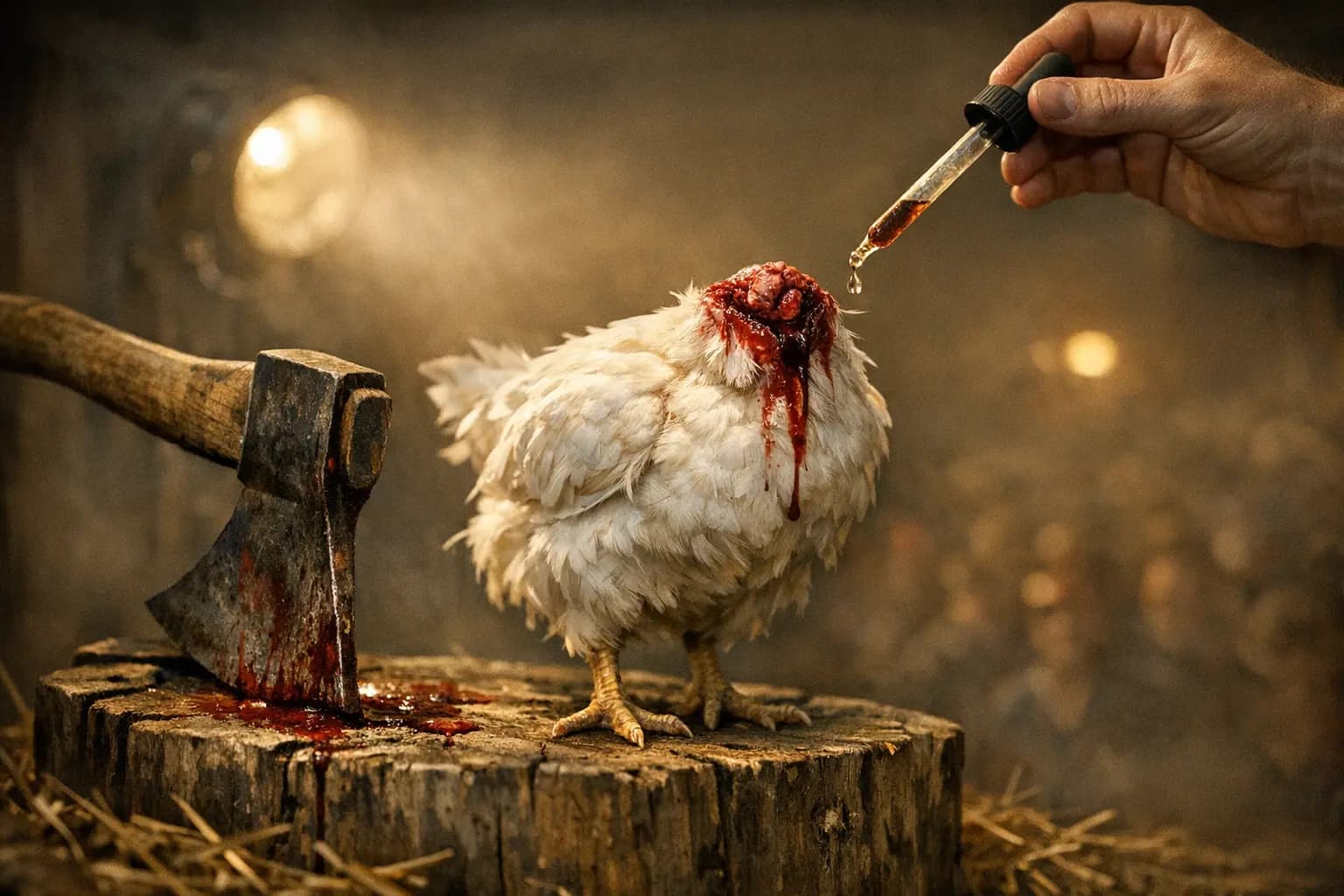
Imagine witnessing a chicken being beheaded… and then watching it calmly stand up, walk around, and continue living.
It sounds like fiction, something pulled from a bizarre horror story or internet myth. But in 1945, this exact scenario became reality on a farm in Colorado. A chicken named Mike defied all expectations of biology and survival, living for an astonishing 18 months without a head.
At first glance, the story seems impossible. After all, the brain controls the body, remove it, and life should end instantly. But Mike’s survival challenges that assumption and reveals something far more fascinating: the body’s ability to function under extremely unusual conditions.
This is not just a strange anecdote. It’s a real case that has been studied, documented, and remembered for decades. And it forces us to ask an unsettling question:
How much of life actually depends on the brain?
The Day Everything Went Wrong (or Right)
The story begins in Fruita, Colorado, in September 1945. A farmer named Lloyd Olsen was preparing chickens for dinner, a routine task on any farm.
When Olsen selected a young rooster later named Mike he expected the process to be quick and uneventful. But when he brought down the axe, something unusual happened.
The cut did not fully sever the chicken’s head in the way intended. Instead of destroying the entire brain, the blade missed a crucial portion: the brain stem.
Even more incredibly, the jugular vein was not completely severed, and a blood clot quickly formed, preventing fatal blood loss.
What happened next stunned Olsen.
Mike didn’t collapse. He didn’t die.
He stood up.
How Could a Headless Chicken Stay Alive?
To understand Mike’s survival, we need to look at the brain’s structure.
The brain is not a single, uniform organ. It consists of different regions with distinct functions. The upper parts of the brain control complex processes such as thinking, perception, and voluntary movement.
But the brain stem the lower portion controls the essentials of life:
Breathing
Heart rate
Basic reflexes
Automatic body functions
In Mike’s case, the axe removed most of the head and higher brain structures but left the brain stem intact. That meant his body could still regulate the basic processes needed to survive.
This is the key reason Mike did not die immediately.
The Role of the Blood Clot
Even with part of the brain intact, survival would normally be impossible due to blood loss.
But Mike experienced another extremely rare stroke of luck.
A blood clot formed quickly at the wound site, effectively sealing major blood vessels and preventing him from bleeding out. Without this clot, his survival would have lasted only seconds.
This combination of an intact brain stem and controlled bleeding is what made Mike’s case so unique.
Life Without a Head: Daily Survival
Surviving the initial event was only the beginning. For Mike to live for 18 months, he required constant care.
Since he had no mouth or beak to eat, Olsen developed a method to feed him using a dropper. Mike was given a mixture of milk and water, along with small grains of food inserted directly into his esophagus.
Olsen also had to regularly clean mucus from Mike’s throat to prevent choking.
This level of care turned what could have been a short-lived curiosity into a long-term survival case.
Remarkably, Mike not only survived, he grew. He reportedly gained weight and maintained a level of activity that made his condition even more astonishing.
From Farm Animal to National Celebrity
News of the “miracle chicken” spread quickly.
At a time when unusual stories traveled primarily through newspapers and word of mouth, Mike became a national sensation. People were fascinated and often disturbed by the idea of a living, headless animal.
Olsen began touring with Mike across the United States. Audiences paid to see him, turning the chicken into a profitable attraction.
At one point, Mike was reportedly valued at $10,000, a huge sum in the 1940s.
His story was featured in major publications, and he became one of the strangest celebrities of his time.
Why Mike’s Case Is So Rare
It’s important to understand that Mike’s survival was not repeatable under normal conditions.
For a similar case to occur, several extremely specific factors must align perfectly:
The brain stem must remain intact
Major blood vessels must not be completely severed
A clot must form quickly
The animal must receive continuous care
If any of these conditions fail, survival is impossible.
This is why Mike’s story remains a one-of-a-kind case rather than a common biological phenomenon.
What Scientists Learned
Mike’s survival provided a unique opportunity to study the role of different brain regions.
It demonstrated that:
Basic life functions can continue without higher brain activity
The brain stem alone can sustain essential bodily processes
Complex behavior is not always required for survival
This case helped reinforce the understanding of how the nervous system is structured and how different parts contribute to life.
Ethical Questions and Public Reaction
While many people were amazed by Mike’s story, others were unsettled.
The idea of a headless animal being kept alive raised ethical questions:
Was it humane to keep Mike alive?
Was he suffering?
Where is the line between curiosity and exploitation?
At the time, these concerns were less publicly debated than they might be today. But from a modern perspective, Mike’s story invites deeper reflection on how humans interact with animals in unusual situations.
The End of Mike’s Life
Mike’s extraordinary life eventually came to an end in March 1947.
While traveling, Olsen forgot to bring the tools needed to clear Mike’s airway. Without proper cleaning, Mike suffocated.
It was a simple, tragic ending to an otherwise unbelievable story.
Why This Story Still Matters Today
Nearly 80 years later, Mike’s story continues to capture attention. Why?
Because it challenges our assumptions about life, death, and the body.
We tend to think of life as something controlled entirely by the brain. But Mike’s survival suggests that life is more layered than that and that certain systems can operate independently under extreme conditions.
It also highlights the role of chance in survival. A slightly different angle of the axe, a delayed blood clot, or a lack of care and Mike would have died instantly.
Instead, he became a biological anomaly that still fascinates scientists and the public alike.
Stranger Than Fiction
Mike the headless chicken is not just a strange historical story.
It’s a reminder that nature doesn’t always follow the rules we expect. Sometimes, survival depends on rare combinations of biology, timing, and sheer luck.
And sometimes… the impossible turns out to be real.