There is something deeply familiar about sleep. It is part of daily life, a cycle that humans and many animals depend on for survival. We sleep for hours, sometimes longer when needed, but always within a rhythm that feels natural and predictable. The idea of sleeping for days might seem unusual, and sleeping for months would feel almost impossible. But in the quiet corners of the natural world, there exists a creature that stretches this concept far beyond anything we experience.
Some snails can sleep not just for extended periods, but for years.
At first, this sounds almost unreal, as if it belongs more to myth than biology. How could an animal simply stop its life for such an extraordinary length of time and then resume it as if nothing had happened? The answer lies in a remarkable survival strategy that allows these small, slow-moving creatures to endure some of the harshest conditions on Earth.
To understand this ability, it is important to look at the environment in which many snails live. Unlike animals that can migrate or escape extreme conditions, snails are limited by their size and speed. They cannot outrun heat, drought, or environmental change. Instead, they have evolved a different solution, one that does not involve movement at all.
They wait.
When conditions become unfavorable, particularly during periods of intense heat or prolonged dryness, certain snail species enter a state known as estivation. This process is similar in some ways to hibernation, but instead of protecting against cold, it is a response to heat and dehydration.
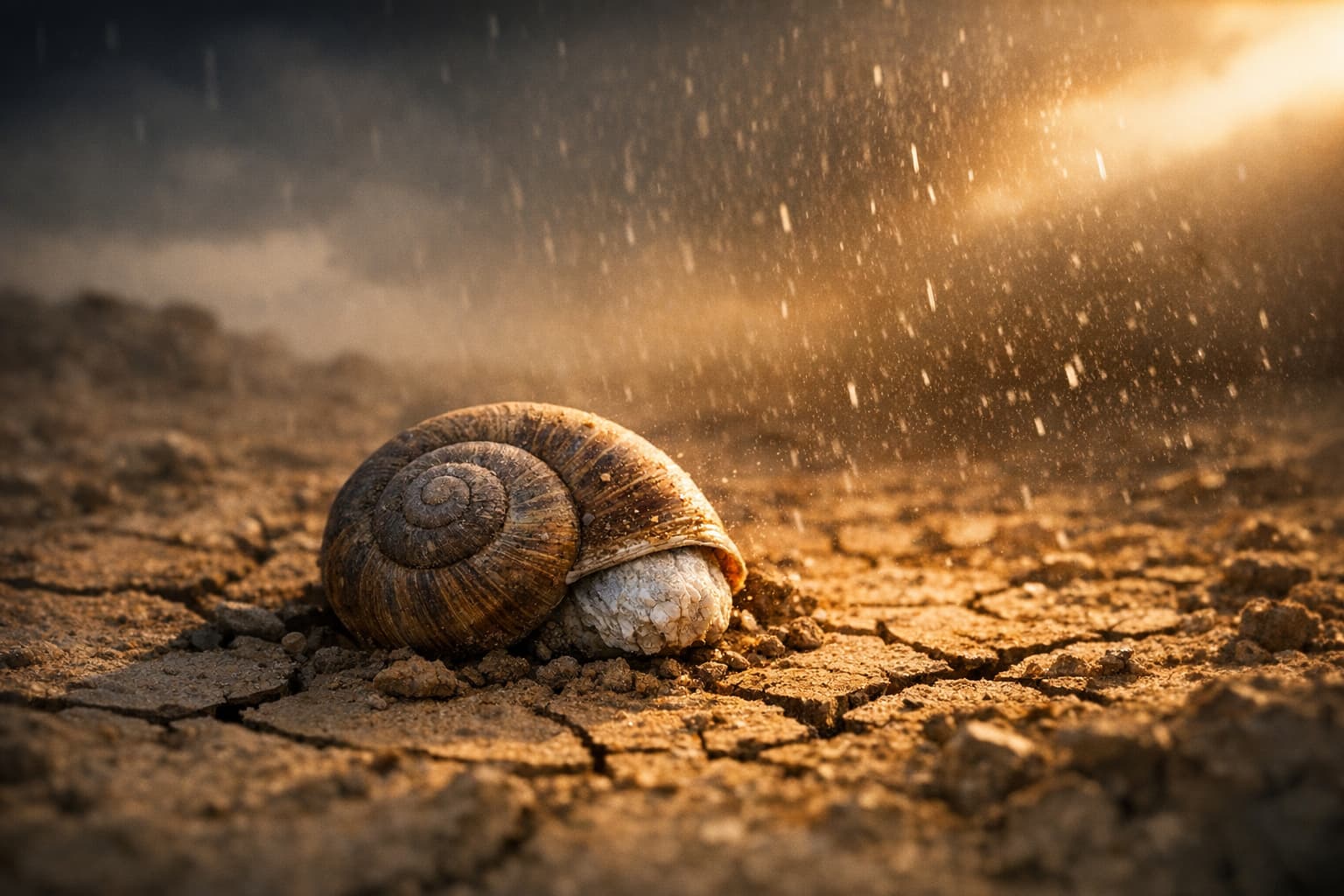
As the environment dries out and water becomes scarce, the snail begins to prepare itself. It retracts its body into its shell, seeking protection from the outside world. Then it produces a thin layer of mucus that hardens over the opening of the shell. This layer acts as a seal, reducing the loss of moisture and shielding the snail from the harsh external environment.
Once sealed inside, the snail’s body undergoes a dramatic transformation.
Its metabolism slows to an almost imperceptible level. Heart rate decreases. Energy consumption drops to the bare minimum required to sustain life. In this state, the snail is not actively living in the way we understand it. It is conserving, preserving, and waiting.
Time, in a sense, loses its usual meaning.
While the world outside continues to change, the snail remains in this suspended state. Days pass, then weeks, then months. In extreme cases, this period can extend for years. Some species have been observed remaining in estivation for up to three years before reemerging.
What makes this even more remarkable is what happens when conditions improve.
When rain finally returns and moisture becomes available again, the hardened seal softens. The snail slowly reactivates its body, emerging from its shell and resuming normal activity. It begins to move, feed, and interact with its environment as if waking from an extraordinarily long sleep.
This ability is not simply a curiosity. It is a highly effective survival mechanism.
In environments where conditions can become deadly, estivation allows snails to avoid the worst periods entirely. Instead of struggling to survive in heat and drought, they step outside of time, waiting until the environment becomes favorable again.
The biological processes behind this are complex and finely tuned. Reducing metabolism to such a low level requires precise regulation within the body. Cells must remain intact, organs must continue functioning at a minimal level, and energy reserves must be carefully managed to last for extended periods.
Scientists study these processes not only to understand snails themselves but also to gain insights into broader biological questions. How do organisms survive extreme conditions? How can life persist with such minimal activity? These questions have implications that extend far beyond a single species.
There is also something philosophically intriguing about this phenomenon. The idea of pausing life, of stepping out of the constant flow of time, challenges the way we think about existence. For humans, life is continuous, marked by constant activity and change. For these snails, life can include long periods of stillness, where survival depends not on action but on the ability to remain inactive.
This contrast highlights the diversity of strategies that life has developed to endure. While some animals rely on speed, strength, or migration, others rely on patience and conservation. Each approach reflects the environment in which the species evolved and the challenges it faces.
It is also worth noting that not all snails possess this ability to the same extent. Estivation varies between species, with some capable of longer periods of dormancy than others. The environments in which they live play a crucial role in shaping this behavior. In regions where droughts are frequent and prolonged, the ability to remain dormant for extended periods becomes particularly valuable.
The shell itself plays an important role in this process. More than just a protective covering, it acts as a controlled environment, helping to regulate moisture and temperature. Combined with the sealing layer produced during estivation, it creates a microhabitat that allows the snail to survive conditions that would otherwise be fatal.
Despite their slow movement and simple appearance, snails are far more complex than they seem. Their ability to endure extreme conditions reveals a level of adaptability that is both subtle and powerful. It is a reminder that survival does not always depend on dominance or speed. Sometimes, it depends on the ability to endure quietly and wait.
In a world that often values constant activity and progress, there is something almost poetic about this strategy. The snail does not fight the environment or attempt to overcome it. Instead, it adapts by stepping back, conserving energy, and allowing time to pass.
When viewed in this way, estivation is more than a biological process. It is a reflection of a different relationship with the world, one where survival is achieved not through force but through patience.
This perspective also invites a broader appreciation for the diversity of life on Earth. Each species carries within it a unique set of adaptations shaped by millions of years of evolution. Some of these adaptations are obvious, while others remain hidden until we take the time to look more closely.
The story of snails that can sleep for years is one of those hidden wonders. It challenges our assumptions, expands our understanding, and reminds us that even the smallest creatures can possess extraordinary abilities.
Standing in a dry landscape where the ground is cracked and lifeless, it would be easy to assume that nothing could survive there for long. Yet beneath the surface, inside tiny shells sealed against the heat, life persists in silence.
Waiting.
And when the rain finally comes, that silence breaks.
The snails emerge, moving slowly across the newly softened ground, continuing a life that had only been paused, not ended.
It is a quiet but powerful reminder that survival can take many forms, and that sometimes, the most effective way to endure is simply to wait for the right moment to begin again.
Sources
https://www.britannica.com/animal/snail