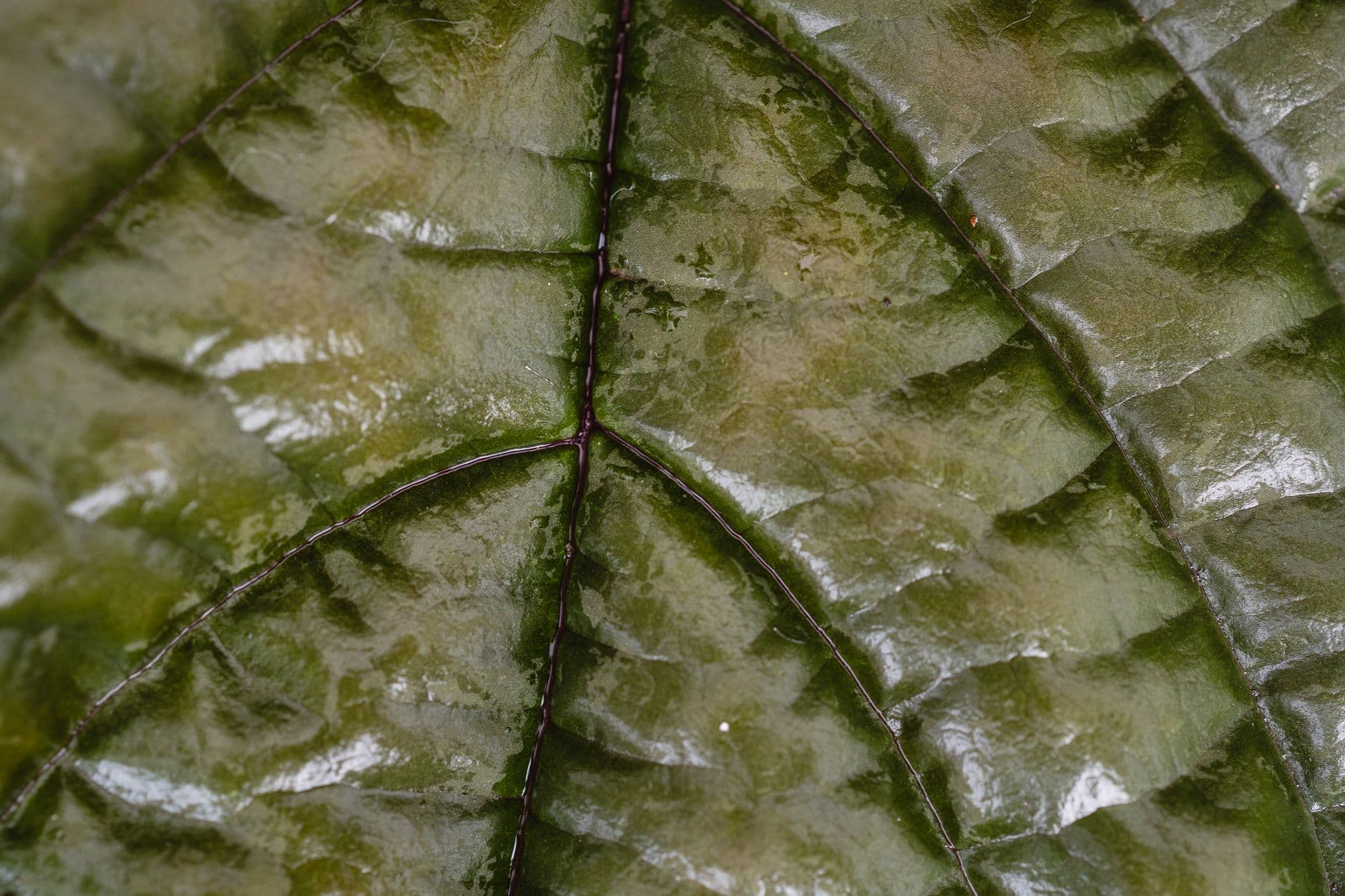
Chinese Money Plant Leaves Reveal Hidden Voronoi Diagram Pattern
Nature has been solving complex mathematical problems for millions of years without a single calculator in sight. A team of researchers recently discovered that the veins in Chinese money plant leaves naturally arrange themselves in a Voronoi diagram pattern, one of geometry's most elegant puzzles.
This isn't some coincidence or observer bias. The pattern is real, measurable, and raises serious questions about how plants optimize their internal structures without any conscious planning.
What Exactly Is a Voronoi Diagram?
A Voronoi diagram is a mathematical structure that divides space into regions based on distance. Imagine a map where each region belongs to the nearest point. Every location in that region is closer to its assigned point than to any other point on the map. It sounds abstract until you see it everywhere.
Architects use Voronoi patterns to design buildings. Urban planners use them to map cities. Computer scientists use them for data analysis. But the Chinese money plant was using this pattern long before humans invented the mathematics to describe it.
How Leaf Vein Geometry Reveals Nature's Blueprint
The discovery came through careful microscopic analysis of Pilea peperomioides, the plant commonly known as the Chinese money plant. Researchers examined the vein arrangement in leaf structures and found something remarkable. The pattern wasn't random or haphazard. Instead, the veins divided the leaf surface into regions that matched Voronoi geometry with startling precision.
According to ScienceDaily, this arrangement appears to be an evolutionary optimization. Plants need to distribute water and nutrients efficiently across every part of their leaves. A Voronoi pattern accomplishes this with minimal overlap and maximum coverage.
This is nature's version of engineering. The plant doesn't think about geometry. It simply grows in whatever way keeps it alive. Over countless generations, that survival pressure shaped leaves into mathematical perfection.
Mathematical Patterns in Plant Structure
The Voronoi discovery joins a growing body of evidence that plants exhibit mathematical precision in their structures. Spiral patterns appear in pinecones and pineapples. Fractals show up in fern fronds and tree branches. The Fibonacci sequence governs flower petal counts across countless species.
But this Voronoi finding feels different. It's not just about counting or observing spirals. It's about a complex geometric solution emerging spontaneously in living tissue.
What makes it even stranger is the efficiency. A Voronoi diagram minimizes wasted space while maximizing reach. For a leaf trying to photosynthesize and transport resources, this matters enormously. The plant that can deliver water to every cell with the least redundancy wins the survival game.
Evolution didn't hand plants a textbook on Voronoi geometry. Instead, plants that grew closer to this pattern survived better. Over millions of years, natural selection refined the design.
Why This Discovery Matters Now
Understanding these patterns could change how humans approach design problems. Architects studying Voronoi diagram applications now have a biological template. Engineers designing networks and distribution systems can look to nature for solutions.
The Chinese money plant itself becomes a study guide. How does the plant achieve this pattern during growth? What cellular signals guide vein development? These questions lead to practical applications in material science and structural design.
Researchers at multiple institutions are now examining other plant species. The suspicion is strong that this pattern appears widely across the plant kingdom. Some plants might use Voronoi geometry more strictly than others, but the principle likely extends far beyond one decorative houseplant.
This work reminds us that mathematics isn't something humans invented and imposed on nature. Often the reverse is true. We discover mathematics by watching what nature already does, then we develop the language to describe it.
The next time you water a Chinese money plant, look closely at its round leaves. You're holding evidence of an ancient negotiation between survival and geometry, written in chlorophyll and cellulose.
Want to explore more about how plants embody mathematical principles? Check out our full collection of plant science articles and discover other ways nature solves complex problems.