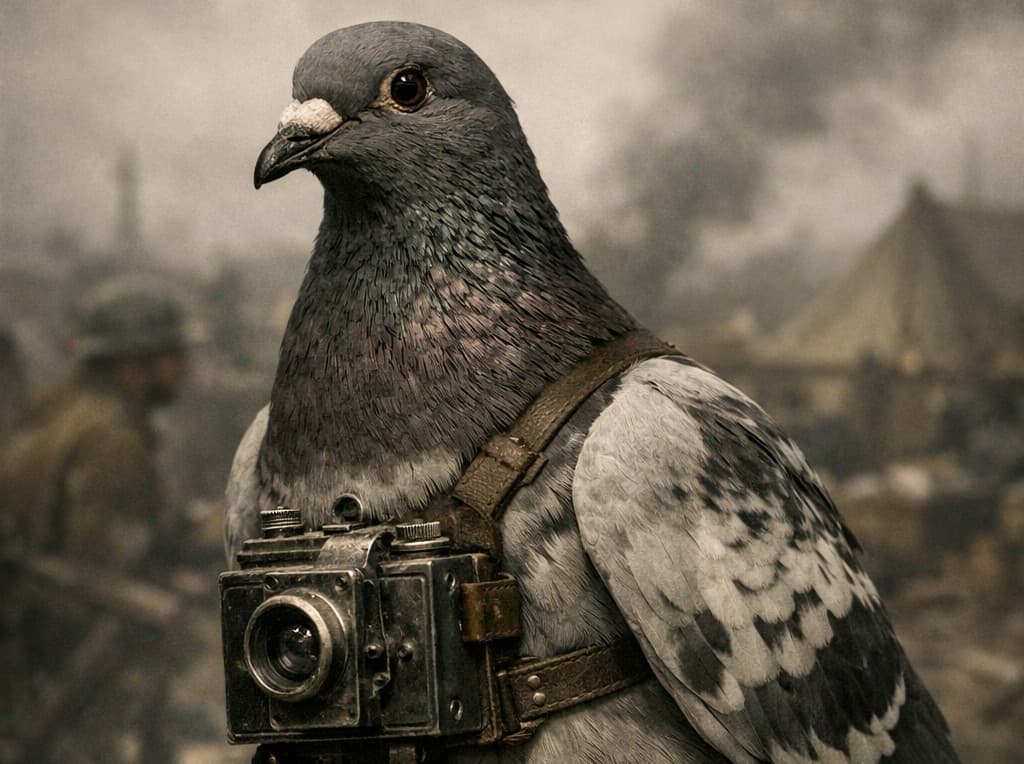
In the world of espionage, innovation often emerges from the most unexpected places. When people think of intelligence operations, they imagine satellites orbiting the Earth, hidden microphones, or highly trained human agents moving silently through foreign cities. Yet during the Cold War, one of the most unusual surveillance tools ever developed did not rely on advanced machinery or complex electronics. It relied on pigeons.
At first, the idea sounds almost absurd. A small bird, commonly seen in city streets and rooftops, hardly seems like a candidate for sophisticated intelligence work. But in an era defined by secrecy, competition, and rapid technological experimentation, even the most unconventional ideas were taken seriously. The possibility that pigeons could be trained to carry cameras and capture images from above was not dismissed as fantasy. Instead, it became the foundation of a real intelligence program.
This unusual chapter in history reveals not only the creativity of intelligence agencies but also the lengths to which nations were willing to go in order to gain an advantage during one of the most tense periods of the twentieth century.
The Cold War Intelligence Race
During the Cold War, the United States and the Soviet Union were locked in a global struggle for influence. Information was one of the most valuable resources in this conflict. Knowing what the other side was doing, where military installations were located, and how infrastructure was developing could make the difference between strategic success and failure.
In the early years of this rivalry, technology had not yet reached the level we associate with modern surveillance. Satellites were still in their infancy, and drones as we know them today did not exist. Intelligence agencies had to rely on creative methods to gather information without being detected.
It was in this context that the Central Intelligence Agency began to explore the use of animals for espionage purposes. Pigeons, with their natural ability to navigate long distances and return to specific locations, quickly became a subject of interest.
From Messengers to Photographers: Project Tacana
For centuries, pigeons had been used as messengers. Their homing instinct allowed them to carry information across great distances, often with remarkable reliability. This made them valuable in times of war long before the Cold War began. The idea of using pigeons for communication was well established.
What the CIA proposed under classified efforts like Project Tacana was something entirely different. Instead of carrying messages, these pigeons would carry cameras.
The concept was both simple and ambitious. If a pigeon could be trained to fly over a specific area, a small camera attached to its body could capture images from above. These images could then be retrieved and analyzed, providing valuable intelligence without the need for human presence. However, turning this idea into reality required overcoming significant engineering challenges.
Designing the Miniature Pigeon Camera
The first obstacle was the camera itself. In the mid-twentieth century, cameras were not as compact or lightweight as they are today. Engineers had to design specialized miniature devices that were small enough for a pigeon to carry without affecting its ability to fly.
These cameras were carefully engineered to be both lightweight and durable. They were mounted on the pigeon’s chest and positioned in such a way that they could capture images during flight. Some designs included automatic, battery-powered timers, allowing the camera to take photographs at regular intervals without any external control.
Conditioning the Birds for Covert Surveillance
The second challenge was training the pigeons. Unlike machines, pigeons could not simply be programmed. They had to be conditioned through repetition and reward. Trainers worked with the birds to guide their flight paths, encouraging them to travel over specific areas before returning to their base.
This process required patience and precision. Each pigeon had to be trained individually, and not all of them were suitable for the task. The success of the program depended on selecting birds with strong homing instincts and the ability to remain calm while carrying the equipment.
The Unique Advantages of Avian Espionage
Despite these difficulties, the program produced surprising results. Test flights demonstrated that pigeons could carry the cameras and return safely, bringing back images that were clear enough to be useful. In some cases, the photographs captured details that would have been difficult to obtain through other means at the time.
The effectiveness of these early experiments challenged assumptions about what was possible. A method that initially seemed impractical began to show real potential.
The use of pigeons also offered a unique advantage. Unlike aircraft or human agents, pigeons did not attract suspicion. A bird flying overhead was a common sight, blending naturally into the environment. This made them an ideal tool for covert surveillance.
The Real-World Limitations of Animal Spies
However, the program was not without its limitations. Controlling the exact path of a pigeon was far more difficult than controlling a machine. While pigeons could be guided and trained, they were still living creatures with their own instincts. Weather conditions, predators, and unpredictable behavior all introduced elements of uncertainty.
There were also practical challenges in retrieving and interpreting the photographs. The cameras had to be recovered, and the film developed before any information could be analyzed. This process took time, limiting the immediacy of the intelligence gathered.
The Declassification of the CIA's Pigeon Program
As technology advanced, new methods of surveillance began to emerge. Satellites provided a way to capture images from space, offering a level of coverage and reliability that pigeons could not match. Drones and other aerial technologies further expanded the possibilities of remote observation. Gradually, the need for animal-based surveillance diminished.
The pigeon program was eventually discontinued, becoming a curious footnote in the history of intelligence operations. When the CIA declassified files on its Cold War animal spy programs, it revealed a stunning look at just how serious these avian missions were. It represents a moment when creativity and necessity intersected, leading to an approach that, while unconventional, was grounded in real scientific and strategic thinking.
Conclusion: Imagination Meets Innovation
Looking back, the idea of pigeons taking photographs may seem unusual, even humorous. But it reflects a broader truth about innovation. Progress often involves exploring ideas that seem unlikely at first. In the context of the Cold War, where the stakes were extraordinarily high, no possibility was too strange to consider.
Today, as we look at the sophisticated surveillance systems that exist, it is easy to forget how different things once were. The idea that a small bird could serve as a tool of intelligence gathering seems almost out of place in an age of satellites and artificial intelligence. And yet, for a time, it worked.
The story of these feathered spies invites us to reconsider what is possible when creativity is combined with necessity. It reminds us that innovation does not always follow a straight path and that even the most ordinary elements of the natural world can be transformed into something extraordinary.