Every night, billions of humans perform the same quiet ritual. Eyes close. Muscles relax. Consciousness fades. For several hours, the brain disconnects from the outside world and drifts into a vulnerable state we call sleep. During that time, breathing continues automatically, awareness disappears, and the body trusts the environment enough to temporarily surrender control.
But for dolphins, that kind of sleep would be fatal.
A dolphin cannot simply close its eyes, shut down its mind, and drift unconscious through the ocean the way humans collapse into bed. If it did, it could stop breathing and drown beneath the surface. So evolution forced dolphins into something far stranger, a biological compromise so extreme that it almost sounds artificial.
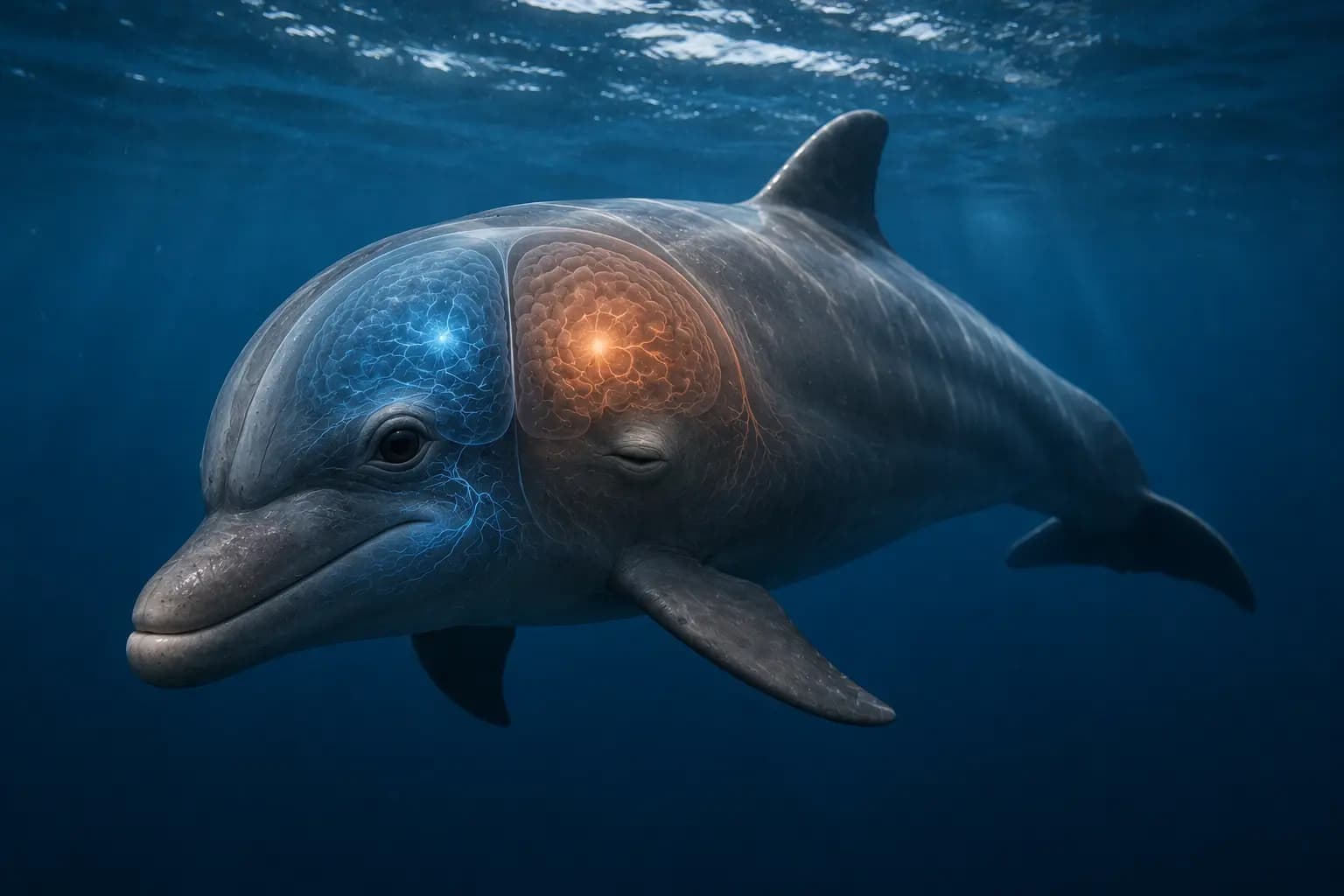
Half of their brain sleeps at a time.
What Is Unihemispheric Slow Wave Sleep?
While one hemisphere enters a deep sleep state, the other remains awake enough to maintain movement, monitor the environment, and most importantly, control breathing. Then after a period of rest, the sides switch. One half wakes up while the other finally powers down. Back and forth, over and over, for their entire lives.
This phenomenon is called unihemispheric slow wave sleep, and it completely reshapes the way we think about rest. Dolphins do not experience sleep as a total shutdown. They experience it as a constant negotiation between exhaustion and survival.
The Evolutionary Necessity of Conscious Breathing
To understand why this evolved, you first have to understand something crucial about cetaceans that most people never realize. Unlike humans, dolphins are conscious breathers.
A human can fall asleep safely because our automatic autonomic nervous system keeps the lungs working even when consciousness disappears. Dolphins do not have that luxury. Every single breath they take requires active, deliberate mental control.
This means a dolphin must remain aware enough to surface regularly and inhale through its blowhole. If both hemispheres of the brain entered deep sleep simultaneously, there would be a serious risk of missing that next breath. In the open ocean, that single mistake would not just be dangerous; it would be lethal.
Sleeping with One Eye Open
And breathing is only part of the problem. The ocean is not a safe place to become completely unconscious. Predators, shifting currents, and environmental threats are constant realities. A fully sleeping dolphin would lose the ability to monitor danger, maintain direction, or stay connected with its pod.
Evolution solved this problem not by eliminating sleep, but by splitting it cleanly in half.
When one hemisphere sleeps, the opposite eye often closes while the other eye remains open. That open eye is directly connected to the awake half of the brain, allowing the dolphin to continue scanning its surroundings even while part of its central nervous system rests. It is one of the strangest sights in nature: an animal simultaneously exhausted and alert, asleep and awake at the exact same time.
The Relentless Demands on Mothers and Calves
Researchers studying cetaceans have observed that even during these resting periods, dolphins continue slow, controlled swimming. Some drift near the surface in a behavior known as "logging" because they resemble floating logs. Others move in highly synchronized patterns with members of their pod.
Mothers and calves display especially fascinating behavior. Newborn dolphin calves barely stop swimming during the first weeks of life, and their mothers stay in constant motion beside them. Studies suggest mothers experience dramatically reduced sleep during this period, remaining vigilant almost continuously to protect, guide, and keep their young in the pod's slipstream. Much like how a mother hamster's instincts undergo extreme behavioral shifts under threat or stress, marine mammals fundamentally rewrite normal parenting rules to keep their lineage alive in unforgiving environments.
High Intelligence on Half a Mind
Imagine what that means biologically. From birth onward, a dolphin’s nervous system exists in a state unlike almost any human experience. There is never a moment of complete surrender. Never a true shut-off. One side of the brain is always standing guard.
And yet, despite this fragmented style of rest, dolphins remain extraordinarily intelligent animals. According to a comprehensive breakdown of cetacean sleep mechanics from Scientific American, their brains adapted not only to survive under these split-shift conditions, but to thrive cognitively. They communicate, cooperate, solve problems, recognize themselves in mirrors, and maintain complex social relationships.
Conclusion: Nature's Unforgiving Logic
This perspective can shift how we think about the body more broadly. Instead of viewing sleep as a fixed, universal design, we see it as a flexible strategic tool. The dolphin's brain is an ongoing performance of radical adaptability—similar to the way human stomach cells replicate under acidic pressure or how frozen desert landscapes challenge our common assumptions.
Everything about dolphin sleep reflects the ocean’s unforgiving logic. Rest exists only in forms that still permit immediate survival. Nature is not designed around comfort; it is designed around continuation. And somewhere beneath the ocean surface tonight, dolphins are still moving through the dark exactly as they always have. Half dreaming. Half awake. Suspended forever between exhaustion and total awareness.