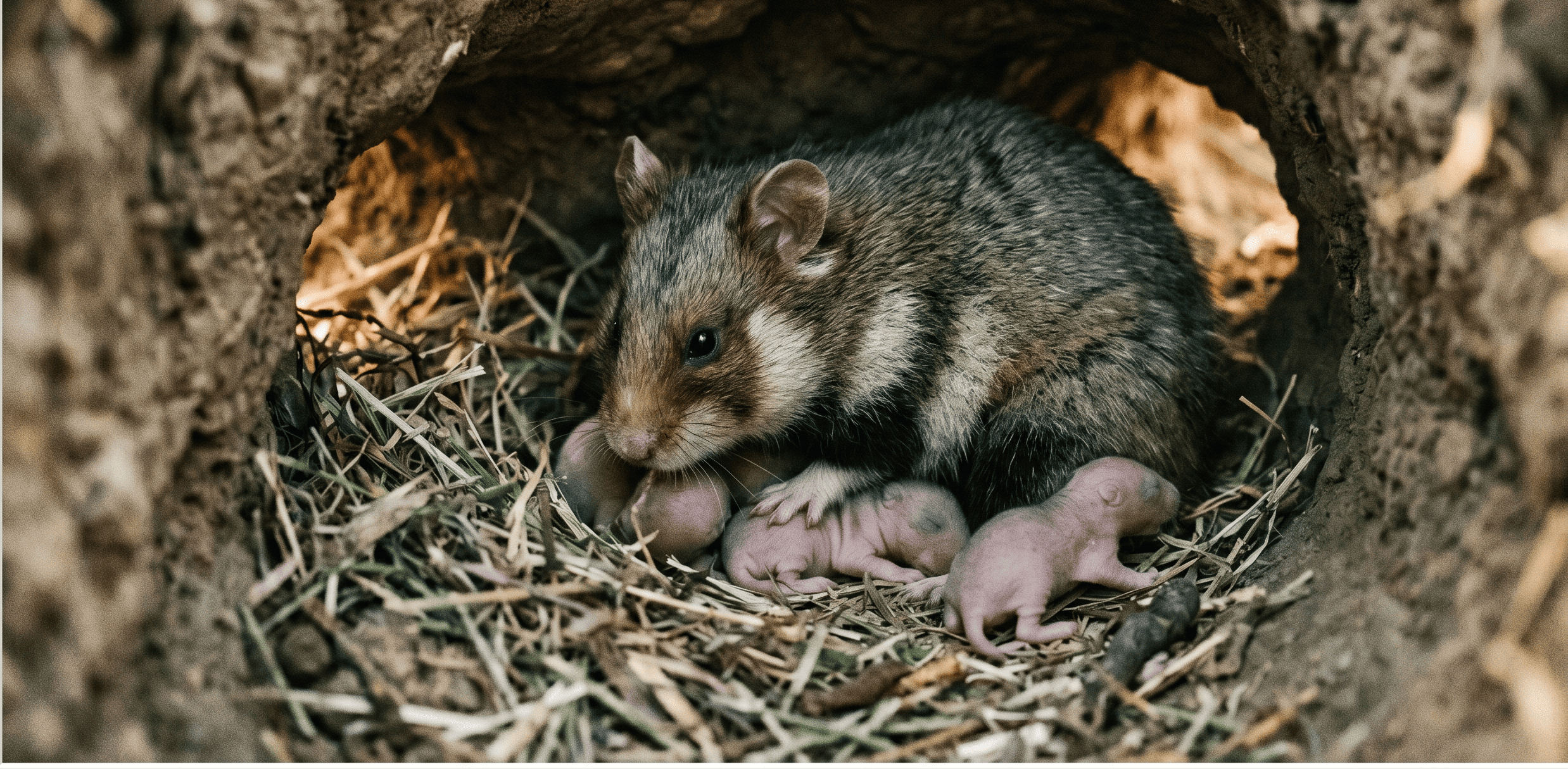
The Dark Instinct Behind a Hamster’s Most Disturbing Behavior
It usually begins with something soft and harmless. A small enclosure, the gentle rustle of bedding, and a mother curled protectively around a cluster of newborn pups no larger than a fingertip. At first glance, it is the kind of scene that invites quiet admiration. Everything appears calm, even tender.
But beneath that fragile calm lies a biological tension that most people never suspect—a tension that can turn the scene into something deeply unsettling in a matter of moments. Because under certain conditions, a mother hamster may do something that feels impossible to reconcile with our typical ideas of care: she may eat her own offspring.
This phenomenon is known scientifically as filial cannibalism (consuming one's own young). It sounds incredibly cruel when viewed through a human lens, but in the realm of evolutionary biology, it is neither random nor malicious. It is a calculated survival response triggered by specific environmental cues.
The Evolutionary Logic of Survival
To understand why this happens, you have to step away from human emotion and look directly at the harsh logic of nature. In the wild, hamsters live in high-risk environments where resources fluctuate wildly, predators are a constant threat, and safety is never guaranteed.
Newborn hamster pups are uniquely vulnerable. They are born hairless, blind, and completely dependent on the nest. They cannot even regulate their own body heat. Because the energy investment required to raise a litter is massive, a mother must constantly run an instinctive cost-benefit analysis of her surroundings. If the signals she receives tell her the environment is compromised, her behavior shifts instantly.
The Triggers: Scent, Stress, and Scarcity
The automatic evolutionary program that controls a mother hamster is highly sensitive to a few critical stressors, especially in captivity.
1. Disruptive Scent Changes
To a hamster, scent is a primary data stream. It tells her whether her offspring are safe or if the nest has been infiltrated. If a human touches the newborn pups or cleans the cage too soon after birth, the scent profile of the nest changes. This sensory disruption creates severe confusion. The mother may no longer recognize the pups as her own, or she may perceive them as permanently compromised by a hidden threat.
2. Resource Allocation and Energy Saving
Producing milk and maintaining body heat for a large litter demands immense caloric energy. If a hamster senses that food resources are scarce, or if her body is physically depleted, attempting to raise the entire litter could result in the death of both herself and all her pups.
By consuming a portion of the litter, she reabsorbs vital nutrients, lowers the metabolic demand on her body, and ensures that the remaining, stronger pups have enough milk to survive. Much like how your body shifts its cellular priorities during physical stress—which we covered when analyzing how the stomach lining continuously rebuilds itself—a hamster’s entire system will ruthlessly prioritize core survival over temporary reproduction.
3. Culling the Weak
If a pup is born with genetic defects, injuries, or fails to develop properly, the mother will instinctively remove it from the nest. In the wild, a weak or dying pup is a liability; its cries and odor can easily draw predators to the entire burrow.
Captivity vs. The Natural Sensory Framework
What confuses pet owners most is that this behavior happens inside quiet, safe households. A clean cage and a full food bowl look perfect to us, but a hamster’s sensory system registers the world differently.
A loud television, a barking dog, or a well-meaning owner repeatedly peaking into the nest can trigger an overload of stress hormones. The mother interprets these disturbances through an ancient evolutionary framework that predates domestication: if the territory is constantly disrupted, the litter is doomed.
According to baseline biological profiles of the hamster family, these animals have evolved to thrive on strict territorial stability. When their environment remains quiet, predictable, and isolated during the first two weeks post-birth, the mother’s nurturing instincts operate completely normally.
Conclusion: The Two Sides of the Same Coin
The image of a hamster carefully gathering bedding for her young and the reality of her turning on them are not separate, conflicting behaviors. They are two different outputs of the exact same survival engine. One strategy activates when conditions are stable; the other deploys when things go wrong.
It is a stark reminder that nature does not operate by human ethics. The line between nurturing life and reclaiming it for self-preservation is incredibly thin. This type of radical biological adaptation is what allows fragile species to endure under immense evolutionary pressure, a theme that mirrors how unique desert animals develop shocking mechanics to survive freezing elements. Survival is rarely gentle, but it is always efficient.