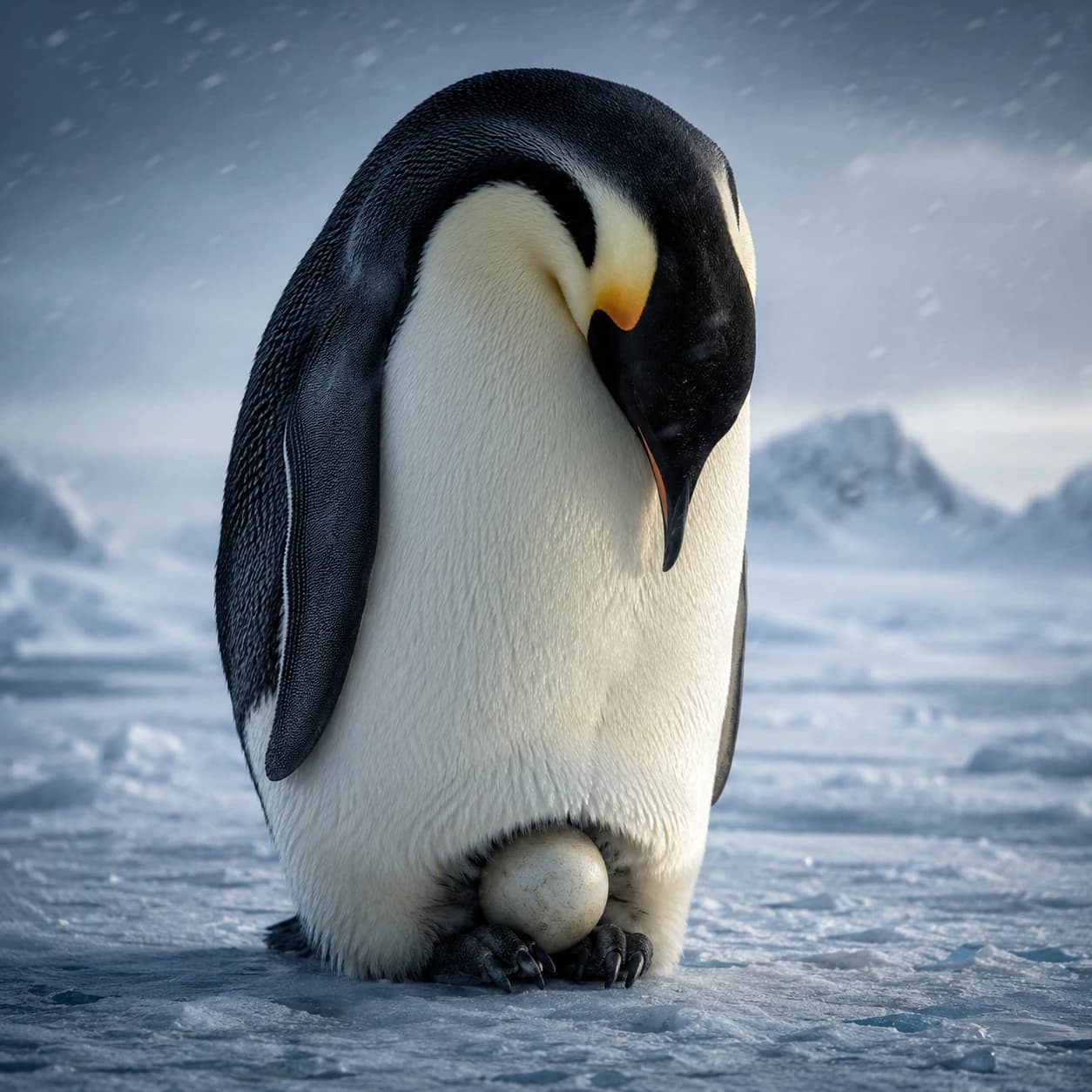
There are places on Earth so hostile that survival itself feels unnatural. Antarctica is one of them. Endless fields of ice stretch beyond the horizon beneath winds powerful enough to strip heat from exposed flesh in seconds. Temperatures plunge far below freezing, storms erase visibility entirely, and during winter, darkness can dominate the landscape for months. Very little life can endure conditions like these for long.
And yet, in the middle of that frozen emptiness, thousands of emperor penguins gather every year to do something almost absurdly dangerous.
They raise their young there.
Not during the brief Antarctic summer when conditions soften slightly, but during the brutal winter itself. And among all the astonishing parts of their breeding cycle, one detail stands above the rest: after the female lays a single egg, she hands it to the male and leaves. What follows is one of the most extreme acts of parental survival in the animal kingdom.
The father balances the egg on top of his feet and keeps it hidden beneath a fold of warm skin called a brood pouch. Then he stands in the Antarctic winter for roughly two months without eating. If the egg touches the ice for even a short time, the embryo inside can die. Everything depends on the father remaining steady.
The Critical Moment: The High-Stakes Egg Transfer
The breeding season begins when emperor penguins travel inland across the sea ice toward traditional nesting grounds. Unlike many birds, they do not build nests from branches or leaves. There is nothing available to build with. Antarctica offers no trees, no grass, and no shelter. Only ice and wind.
The female lays a single egg, and from that moment, the transfer becomes critical. The egg cannot simply be set down while the parents switch places. Exposed to Antarctic temperatures, it can begin freezing almost immediately. So the parents perform an incredibly delicate exchange, carefully rolling the egg from the female’s feet onto the male’s without letting it touch the ground.
Even among experienced penguins, mistakes happen. An egg dropped onto the ice during severe cold may not survive.
Once the male secures the egg beneath his brood pouch, the female leaves for the ocean. She has depleted most of her energy producing the egg and must feed. Her journey can stretch for dozens of miles across shifting ice before she reaches open water. There she hunts fish, squid, and krill while the male remains behind with the egg.
The Anatomy of Survival: Sixty Days of Starvation
This is when the true endurance begins. For approximately sixty to seventy days, the father does almost nothing except survive and protect the egg. He does not hunt. He does not eat. He cannot abandon the egg even briefly. Instead, he relies entirely on fat reserves stored before the breeding season began.
Meanwhile, the Antarctic winter intensifies around him. Winds can exceed one hundred kilometers per hour. Temperatures can fall below minus forty degrees Celsius ($100\text{ km/h}$ and $-40^{\circ}\text{C}$). The cold is so extreme that exposed skin would freeze rapidly. Yet the male emperor penguin remains in place, balancing the future of his offspring on his feet while slowly burning through his own body fat to stay alive.
The brood pouch is what makes this possible. This fold of feathered skin covers the egg and keeps it pressed against a warm patch of the father’s body. Inside that pouch, the temperature remains stable enough for the embryo to continue developing despite the frozen world outside.
Thermoregulation and the Geometry of the Huddle
But warmth alone is not enough. The fathers also survive through absolute social cooperation. Emperor penguins gather into tightly packed formations called huddles, sometimes containing thousands of individuals.
They press against one another to conserve heat, rotating positions constantly. Penguins on the outer edge slowly move inward while others take their place, allowing the group to distribute exposure to the freezing wind. Much like how a mother hamster relies on internal calculations to balance nest energy, the penguin huddle is a mathematical masterpiece of heat conservation.
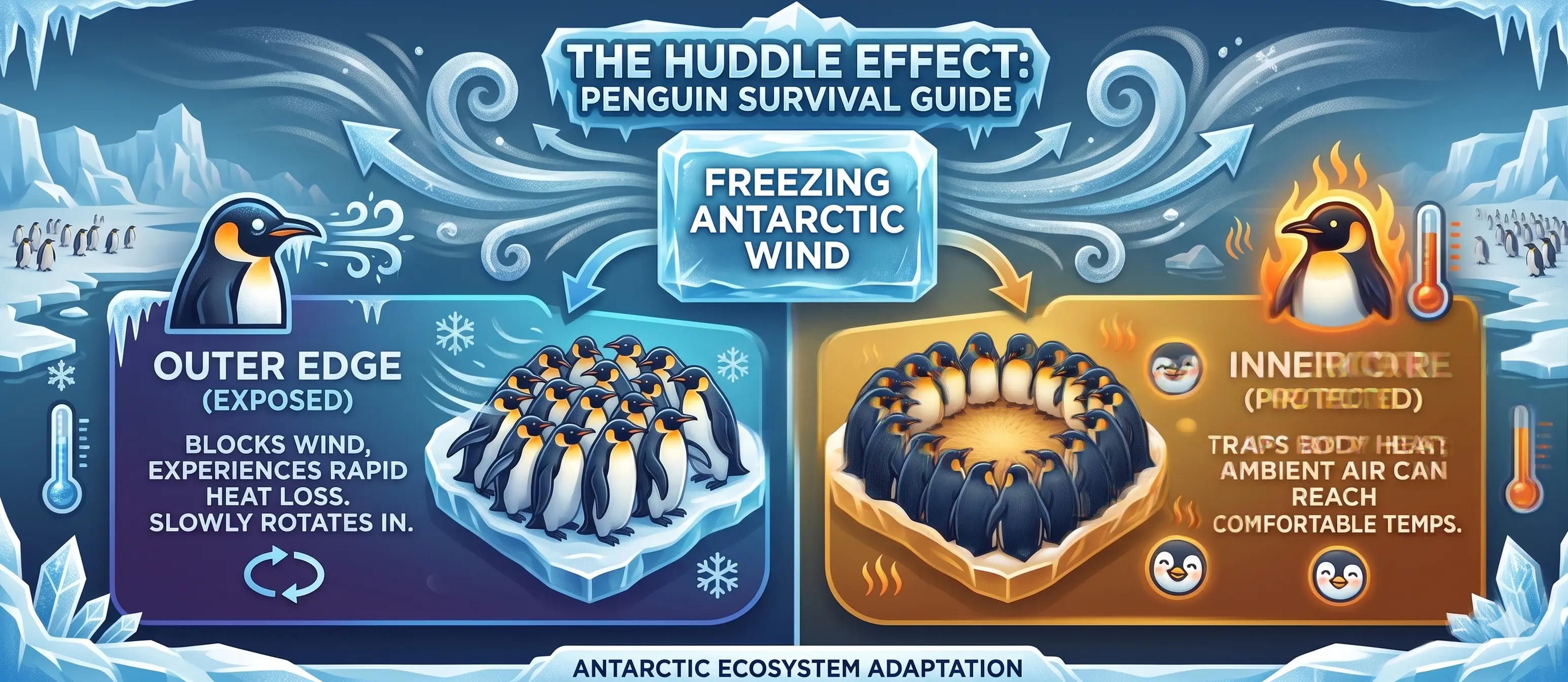 Seen from above, these huddles look almost alive, slowly shifting and pulsing across the ice. Without them, many males would likely die before the eggs hatch.
What makes this even more remarkable is the level of patience involved. Humans often associate parenting with active care, feeding, protecting, teaching. Emperor penguin fathers do almost none of these things during incubation. Their role is something more primitive and relentless: stand still, protect the egg, and endure.
Timing is Everything: The Esophageal Milk Contingency
By the end of the incubation period, many males have lost enormous amounts of body weight, often approaching the edge of physical collapse. Yet they continue waiting for the females to return from the sea.
If the female returns too late, the male may be forced to abandon the egg or newly hatched chick in order to save himself from starvation. In some cases, fathers attempt to feed chicks temporarily with a milk-like secretion produced in their esophagus, buying precious time until the mother arrives with food from the ocean.
According to Britannica's evolutionary profile of the emperor penguin, their circulatory systems are uniquely adapted to minimize heat loss in exposed extremities using countercurrent heat exchange—a feature that keeps them standing long after other animals would freeze. This level of biological mastery is similar to how cetaceans divide brain function to stay alert while sleeping.
Conclusion: A Triumph of Biological Discipline
The father’s vigil eventually ends when the chick hatches and the female returns from the sea with food. The exhausted male finally transfers responsibility and begins his own long journey back toward open water to feed for the first time in months.
Only then does the full cost of incubation become visible. A bird that stood through an Antarctic winter carrying a fragile life on his feet now leaves the colony nearly starved, having sacrificed enormous amounts of energy for a single offspring. That is what emperor penguin parenting truly looks like beneath the surface. It is a testament to how extreme biological discipline can overcome a world completely devoid of life's standard requirements.