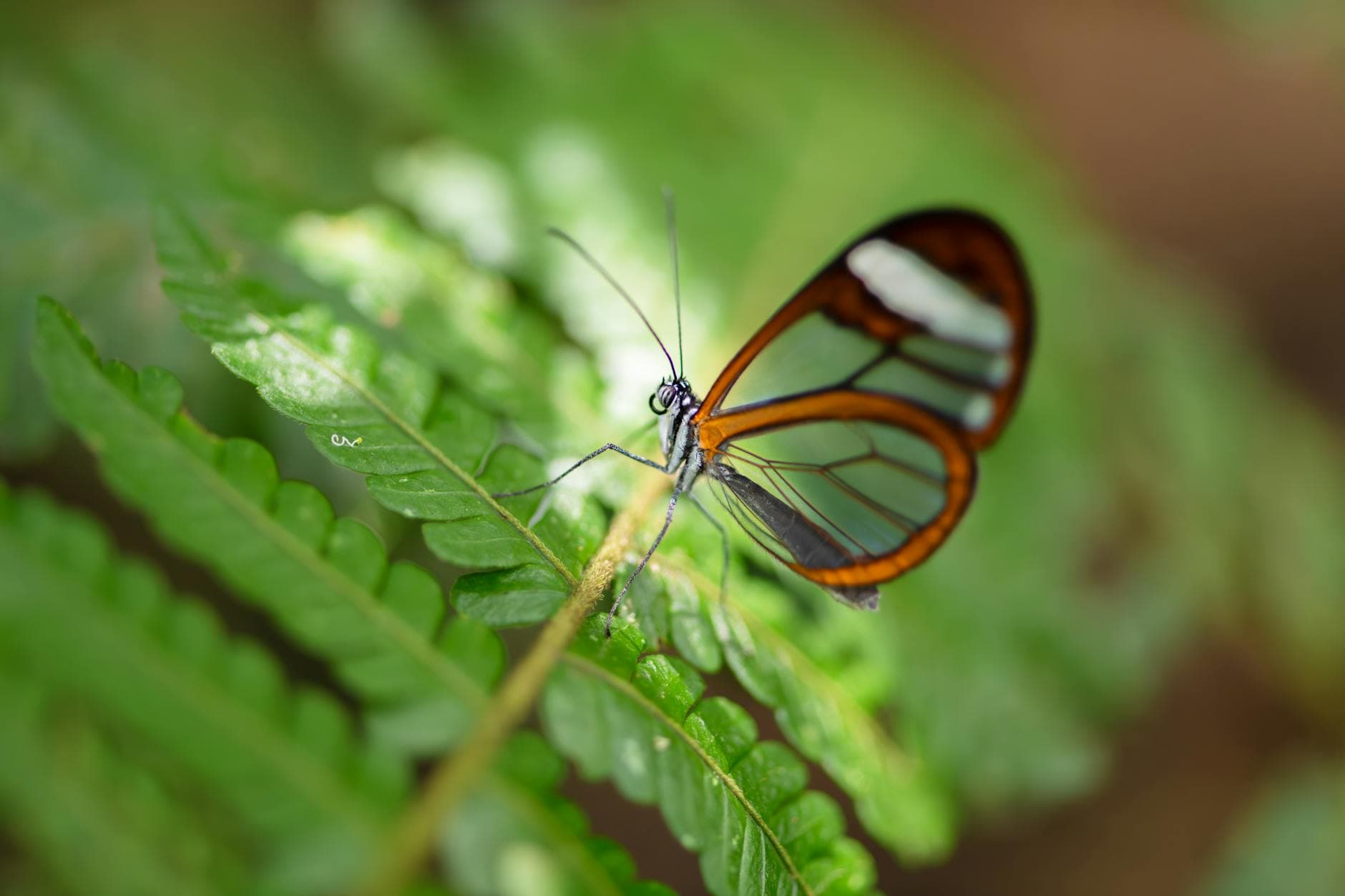
The Glasswing Butterfly: Nature's Most Transparent Insect
The glasswing butterfly can literally disappear in front of your eyes because its wings are completely see-through. Yes, you read that right—this bizarre insect from Central and South America has evolved wings made of transparent material that renders it nearly invisible to predators.
This isn't science fiction. This is real biology.
How Transparent Insects Became Evolution's Invisibility Cloak
The glasswing butterfly's transparency is so effective that predators struggle to spot them even when they're flying directly overhead. Scientists discovered that these weird insects don't actually have pigments like most butterflies—they have something far more ingenious.
Instead of relying on color for camouflage, the glasswing's wings are packed with microscopic structures that bend light in extraordinary ways. The wing material functions like optical glass, bending light rays around the insect's body without reflecting them back to watching eyes.
Researchers at the University of Akron found that the wing membrane contains nanostructures only 200 nanometers wide. These structures scatter light in such a specific way that predators' eyes literally slide past the butterfly without registering its presence.
Strange Insect Adaptations: Why Become Invisible?
The glasswing butterfly lives in rainforests where visibility is constant danger. Flying through dense vegetation means crossing paths with predators at every turn. For this insect species, invisibility beats speed or agility any day.
What makes this adaptation even stranger is that the butterfly still needs to see itself during mating season. The wing transparency creates a biological paradox: how do they find mates when they're essentially invisible? The answer reveals another layer of evolutionary genius.
The glasswing's body remains darkly colored while wings stay transparent. During courtship, males can spot females by their dark bodies even though the wings vanish. It's nature's perfect compromise between survival and reproduction.
Other Bizarre Insect Abilities You Won't Believe
The glasswing isn't alone in the weird insects hall of fame. Nature has engineered countless other impossible-seeming adaptations across the insect world.
The mantis shrimp can see 16 color receptors compared to humans' measly three. The dragonfly's wings beat at 200 times per second, allowing it to hover, accelerate backward, and perform aerial acrobatics that defy physics. The bombardier beetle shoots boiling hot chemical spray from its abdomen as defense.
But the glasswing represents something rarer: an insect that evolved transparency instead of armor, speed, or chemical weapons. It chose invisibility as its survival strategy—and it works spectacularly.
The Science Behind Nature's Transparency
Scientists initially thought the glasswing's transparency was accidental. They assumed the butterfly simply lacked pigmentation. Research proved them wrong in the most spectacular way possible.
The wing structure actively maintains transparency through what physicists call photonic engineering. The nanostructures are arranged in precise patterns that prevent light from being absorbed or reflected. Instead, light passes straight through as if nothing were there.
This discovery has inspired biomimetic technology. Engineers are now using glasswing butterfly wing structure as a blueprint for creating less reflective solar panels, camera lenses, and display screens. One weird insect's survival mechanism could revolutionize human technology.
The natural world continues proving that reality often surpasses imagination. Here's a creature that solved the visibility problem through physics rather than evolution's typical toolkit.
What Makes Transparent Insects So Rare?
Despite being such an effective strategy, true transparency is vanishingly rare among insects. Only a handful of species have evolved this ability. Why? Transparency requires extreme precision in structure and material composition.
Most insects benefit more from speed, strength, or chemical defenses. Transparency demands a specific environmental niche—and the resources to build such delicate, specialized structures. The glasswing butterfly succeeded where countless others couldn't.
Want to explore more creatures that pushed evolution to its absolute limits? Check out our full collection of strange insect discoveries that'll make you question everything you thought you knew about nature's designs.