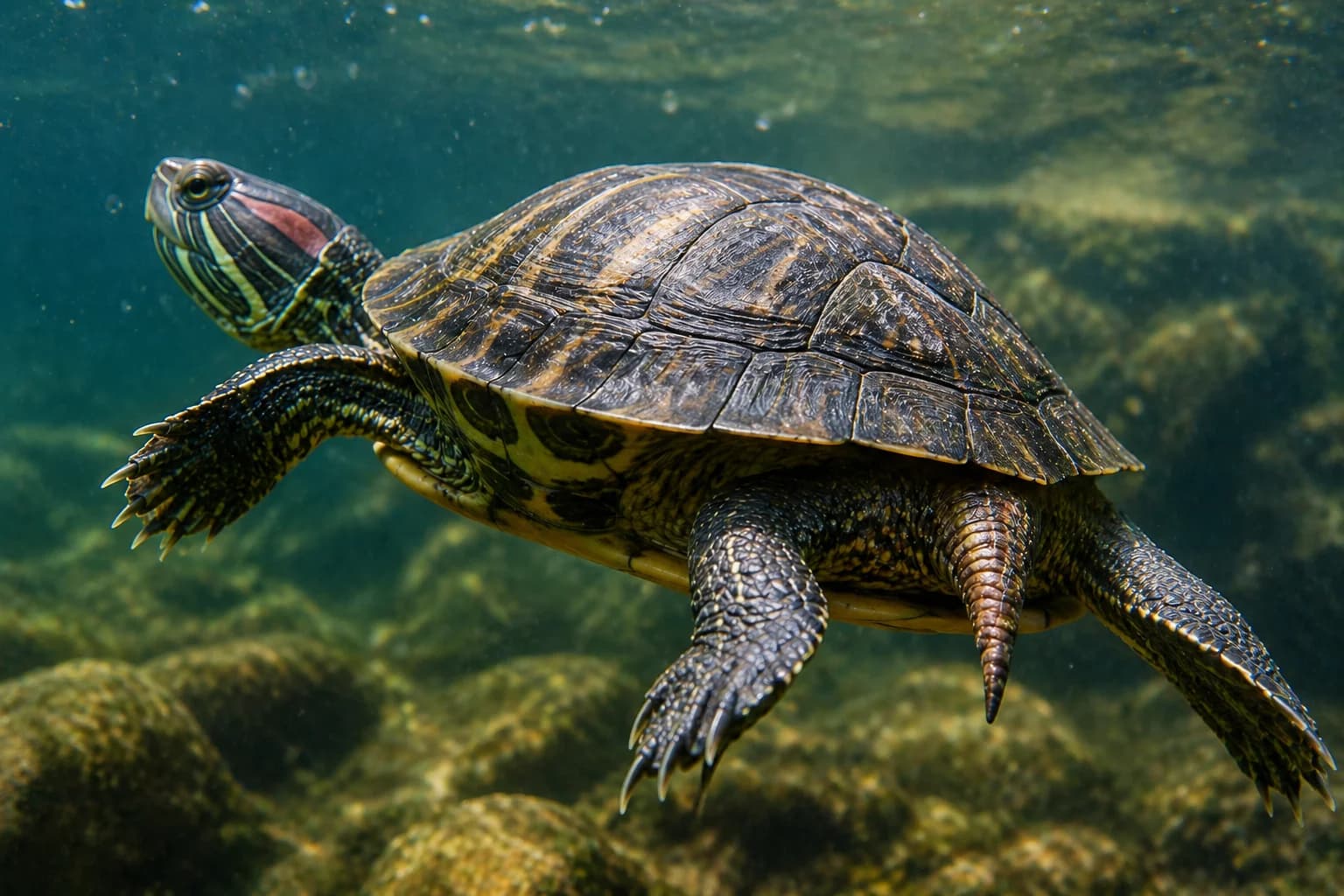
At first glance, turtles seem like the definition of calm and simplicity. They move slowly, spend long hours basking in the sun, and glide quietly through water with an almost effortless grace. Nothing about them suggests anything particularly unusual beyond their shells and longevity. Yet beneath this calm exterior lies one of the strangest and most fascinating survival adaptations in the animal kingdom, one that challenges our basic understanding of how breathing works.
Some turtles can breathe through their rear end.
It sounds almost like a joke, something made up to surprise or amuse, but it is entirely real. This ability is not a trick or an exaggeration. It is a carefully evolved biological process that allows certain freshwater turtle species to survive in conditions that would otherwise be impossible for them.
The Harsh Reality of Frozen Winter Habitats
To understand why this adaptation exists, it is important to imagine the environment these turtles inhabit, especially during winter. In colder regions, lakes and rivers can freeze over, sealing the surface with thick layers of ice. For animals that rely on air, this creates a serious problem. The usual act of surfacing to breathe becomes difficult or even completely impossible.
For most air-breathing animals, this would mean suffocation. But some turtles have found a different way.
What Is Cloacal Respiration?
Instead of relying entirely on their lungs, they can extract oxygen directly from the water. This process is known as cloacal respiration, named after the cloaca, a multipurpose opening found in reptiles that serves for excretion and reproduction. In certain turtle species, this structure also plays a crucial role in breathing.
Inside the cloaca are specialized sacs lined with tiny structures called papillae. These structures are rich in blood vessels and are designed to absorb oxygen from the surrounding water. When the turtle draws water into these sacs, oxygen passes through the thin membranes and enters the bloodstream, while carbon dioxide is released in return.
It is, in essence, a form of underwater breathing.
Of course, this does not replace lung breathing entirely. Turtles still rely on their lungs when they are active and able to surface. But during periods when surfacing is not possible, cloacal respiration becomes a vital backup system.
Metabolic Shifts During Brumation
Winter is where this adaptation becomes especially important. As temperatures drop, turtles enter a state similar to hibernation, often referred to as brumation. Their metabolism slows dramatically, reducing their need for oxygen.
They become almost motionless, conserving energy and minimizing their bodily functions. In this state, the small amount of oxygen absorbed through cloacal respiration is enough to keep them alive. The combination of reduced energy demand and alternative oxygen intake creates a delicate balance that allows survival in an otherwise lethal environment.
What makes this even more remarkable is how efficient the system is under such conditions. Cold water actually holds more dissolved oxygen than warm water, which works in the turtle’s favor. While the environment may seem harsh and uninhabitable, it provides exactly what the turtle needs to sustain itself during its long, inactive period.
The "Bum-Breathing" Fitzroy River Turtle
Different species have developed this ability to varying degrees. One of the most famous examples is Australia's unique Fitzroy River turtle (Rheodytes leukops), often referred to as the “bum-breathing turtle” due to its extreme reliance on cloacal respiration. This species can obtain a significant portion of its oxygen in this way, allowing it to remain submerged for extended periods without needing to surface at all.
Other species, such as certain North American freshwater turtles, also use cloacal respiration, particularly during winter months when ice covers their habitats. While the extent of their reliance may differ, the underlying principle remains the same.
The Slow, Persistent Force of Evolution
This adaptation highlights a broader theme in evolution, which is the ability of life to find solutions to seemingly impossible problems. When traditional methods are no longer sufficient, new pathways emerge, often in unexpected ways.
For humans, breathing is a straightforward process involving lungs and air. The idea of extracting oxygen through another part of the body feels unnatural because it falls outside our experience. But in the natural world, there is no single way to solve a problem. There are countless variations, each shaped by the pressures of the environment and the slow, persistent force of evolution.
Cloacal respiration is one of those variations.
It is also a reminder that what may appear strange or even humorous at first glance often has a deep biological purpose. The phrase “breathing through their butt” might sound amusing, but behind it lies a sophisticated system that has been refined over millions of years.
There is also a certain elegance in how this system integrates with the turtle’s overall lifestyle. Turtles are already adapted to slow movement and low energy consumption. Their shells provide protection, allowing them to remain still without constant vigilance. Their metabolism can adjust to long periods of inactivity. Cloacal respiration fits naturally into this framework, complementing their existing adaptations.
Spring Awakening: Returning to Normal Lung Function
Together, these traits create a survival strategy that is both simple and highly effective. When spring arrives and the ice melts, the turtles gradually become more active. Their metabolism increases, their need for oxygen rises, and they return to using their lungs as their primary means of breathing. The cloacal system remains available, but it is no longer the main source of oxygen.
Life resumes its usual rhythm.
From the outside, nothing about the turtle appears to have changed. It moves through the water as it always has, seemingly unaware of the remarkable process that sustained it through the harsh winter months. But hidden within its biology is a story of adaptation and resilience that few would ever suspect.
How Turtle Respiration Benefits Modern Medical Research
This ability also raises interesting questions for science. Understanding how turtles manage oxygen exchange in low-energy states could provide insights into medical research, particularly in areas related to oxygen deprivation and metabolic control. Studying such systems may one day contribute to advances in human health, showing once again how knowledge from the natural world can influence unexpected fields.
More broadly, the existence of cloacal respiration challenges us to rethink what we consider normal or possible. It expands our understanding of biology and reminds us that the natural world is far more diverse and inventive than we often realize.
It is easy to overlook animals like turtles because they appear familiar and unremarkable. They do not have the speed of predators or the size of large mammals. Yet their quiet existence hides adaptations that are just as extraordinary as anything found in more dramatic species.
In the stillness of a frozen lake, beneath a layer of ice, a turtle rests motionless in the cold water. It does not rise for air. It does not move in search of food. And yet, it lives. Water flows gently in and out of hidden sacs within its body, carrying with it the oxygen needed to sustain life. Time passes slowly, almost unnoticed, until the environment changes once again.
Then, when the ice breaks and the water warms, the turtle stirs, returning to the surface and to the familiar act of breathing air. What seems impossible becomes natural. And what sounds bizarre becomes a quiet, essential part of survival in a world where life always finds a way to continue.