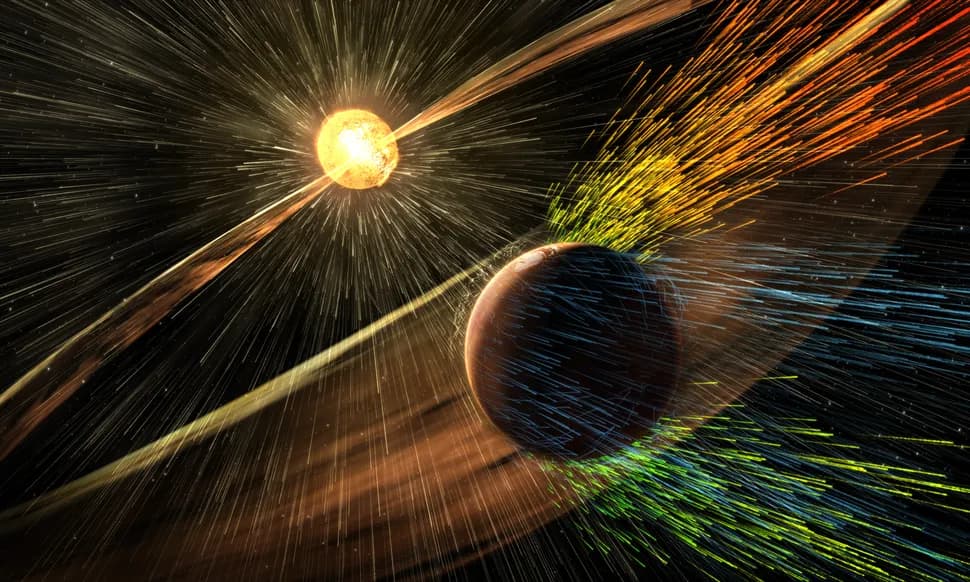
Space weather is one of the most powerful and unpredictable forces in the solar system. Violent eruptions from the Sun can send enormous waves of radiation and charged particles racing through space at millions of kilometers per hour. When these events reach planets, they can disrupt satellites, damage electronics, and dramatically alter planetary atmospheres.
In May 2024, one of the most powerful solar storms in more than two decades erupted from the Sun and swept across the inner solar system. Earth experienced spectacular auroras that stretched far beyond the polar regions. But while people on Earth watched colourful lights in the sky, something far more dramatic was unfolding hundreds of millions of kilometers away.
Orbiting spacecraft around Mars witnessed the same solar superstorm striking the Red Planet directly. Two European Space Agency missions, Mars Express and the ExoMars Trace Gas Orbiter, captured unprecedented data as the storm slammed into the Martian atmosphere. Scientists later described the moment as extraordinarily fortunate because the spacecraft happened to be observing Mars at exactly the right time.
The result was one of the most detailed observations ever recorded of how a solar superstorm interacts with another planet.
Understanding Solar Superstorms
To understand what happened at Mars, it is important to know how solar storms form.
The Sun constantly releases energy in the form of light, radiation, and charged particles. Most of the time this activity is relatively stable. However, the Sun periodically produces violent eruptions known as solar flares and coronal mass ejections.
A solar flare is a sudden burst of radiation caused by magnetic energy being released in the Sun’s atmosphere. A coronal mass ejection occurs when billions of tons of plasma are hurled into space along with powerful magnetic fields.
When these events occur together, they can create what scientists call a solar storm. In extreme cases the storm becomes so powerful that it is classified as a solar superstorm.
These storms send enormous clouds of energetic particles across the solar system. When they encounter a planet, the results depend largely on whether that planet has a magnetic field.
Why Mars Is More Vulnerable Than Earth
Earth is protected by a powerful magnetic field known as the magnetosphere. This invisible shield deflects most charged particles coming from the Sun. When solar particles reach Earth, they are guided toward the poles where they collide with atmospheric gases and create auroras.
Mars, however, is very different.
Unlike Earth, Mars lost its global magnetic field billions of years ago. Without this protective shield, the Martian atmosphere is far more exposed to solar radiation and energetic particles.
When a solar storm reaches Mars, there is very little to stop it from directly interacting with the upper atmosphere.
During the May 2024 event, this vulnerability became dramatically clear.
The Solar Storm Reaches Mars
As the solar superstorm moved through space, it eventually reached Mars and struck the planet’s upper atmosphere.
The orbiting spacecraft detected an extraordinary surge of charged particles and radiation. Measurements showed that Mars was hit with the equivalent of around two hundred days of normal radiation in only sixty-four hours.
This sudden bombardment dramatically altered the planet’s upper atmosphere.
Electrons were ripped from atoms and molecules, creating a massive surge of charged particles in the ionosphere. Scientists measured a forty five percent increase in electrons at an altitude of about one hundred ten kilometers and an astonishing two hundred seventy eight percent increase at around one hundred thirty kilometers above the surface.
These numbers represent the most intense atmospheric response to a solar storm ever recorded at Mars.
The Role of Mars Express and the Trace Gas Orbiter
The extraordinary observations were made possible thanks to two spacecraft operated by the European Space Agency.
Mars Express has been orbiting the planet since 2003 and has spent decades studying the Martian surface and atmosphere. The ExoMars Trace Gas Orbiter arrived much later, in 2016, with the goal of studying atmospheric gases and searching for traces of methane that might hint at past or present life.
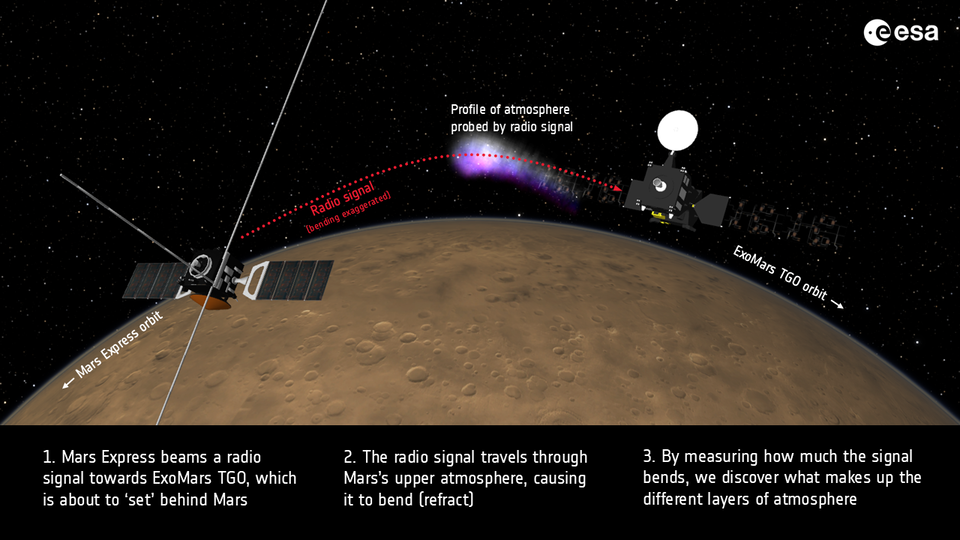
During the solar storm the two spacecraft were performing a technique known as radio occultation.
This method involves sending a radio signal from one spacecraft through the atmosphere to another spacecraft. As the signal travels through different atmospheric layers, it bends slightly depending on temperature, density, and charged particles.
By analyzing how the signal changes, scientists can reconstruct detailed information about the structure of the atmosphere.
Because the spacecraft happened to be performing this experiment shortly after the solar flare erupted, they were able to observe the storm’s effects almost immediately. Researchers later explained that they normally perform this type of observation only a few times per week, making the timing extremely fortunate.
Spacecraft Glitches During the Storm
The solar superstorm did not just affect Mars. It also interfered with the orbiting spacecraft themselves.
High energy particles from the storm triggered temporary computer errors inside both orbiters. These glitches are a known hazard of space weather, since energetic particles can disrupt electronic systems.
Fortunately, the spacecraft were designed to survive exactly this type of environment. Radiation hardened electronics and automatic error correction systems allowed both spacecraft to recover quickly without long term damage.
Even so, the event served as a reminder that powerful solar storms can threaten satellites and robotic missions throughout the solar system.
What the Storm Revealed About Mars
Beyond the immediate effects of the storm, the data collected during the event may help scientists solve one of the greatest mysteries about Mars.
Billions of years ago Mars was very different from the dry and barren world we see today. Evidence suggests that the planet once had rivers, lakes, and possibly even oceans of liquid water.
Over time most of that atmosphere and water disappeared into space.
One leading explanation is that the continuous bombardment of solar wind gradually stripped the atmosphere away. Without a strong magnetic field to protect it, Mars slowly lost much of its air and water over billions of years.
The solar superstorm provided a rare opportunity to observe this process in action.
By measuring how the atmosphere responded to the sudden burst of energy and particles, scientists gained valuable insight into how solar activity interacts with the Martian atmosphere and contributes to atmospheric loss.
 ESA's Mars orbiters watch solar superstorm hit the Red Planet
Challenges for Future Mars Missions
The observations also have important implications for future exploration of Mars.
Solar storms can interfere with radio communication, damage spacecraft electronics, and expose astronauts to dangerous levels of radiation.
During the storm, the sudden increase in charged particles in the Martian atmosphere could have disrupted radar signals used by spacecraft to study the planet’s surface. Understanding these effects is essential for planning future missions.
As space agencies prepare for eventual human missions to Mars, predicting and monitoring solar activity will become increasingly important.
Astronauts traveling to Mars or living on its surface would have far less protection from solar storms than astronauts aboard the International Space Station.
Developing reliable space weather forecasting systems may therefore become a critical part of interplanetary exploration.
Why the Timing Was So Lucky
Scientists often rely on chance when studying unpredictable cosmic events.
Solar eruptions occur randomly, and spacecraft instruments are not always observing the right place at the right time. In many cases storms occur when spacecraft are not conducting measurements that could capture detailed data.
In this case the orbiters happened to begin their atmospheric experiment just minutes after the solar flare struck Mars.
Because of this coincidence, researchers obtained one of the clearest pictures yet of how a solar superstorm affects the Martian atmosphere.
Without that timing, scientists might have missed the most dramatic phase of the storm entirely.
The solar superstorm that struck Mars in May 2024 provided scientists with a rare and valuable glimpse into the powerful relationship between the Sun and planetary atmospheres.
As the storm reached the Red Planet, orbiting spacecraft recorded a dramatic surge of radiation and charged particles that flooded the upper atmosphere. The event delivered the equivalent of two hundred days of radiation in less than three days and produced record breaking increases in atmospheric electrons.
Thanks to the fortunate timing of observations by Mars Express and the ExoMars Trace Gas Orbiter, researchers captured unprecedented measurements of this cosmic event.
These observations not only reveal how Mars responds to extreme solar activity but also help scientists understand how the planet may have lost much of its atmosphere over billions of years.
The findings highlight the dynamic and sometimes dangerous nature of space weather and remind us that even distant planets remain closely connected to the restless star at the center of our solar system.