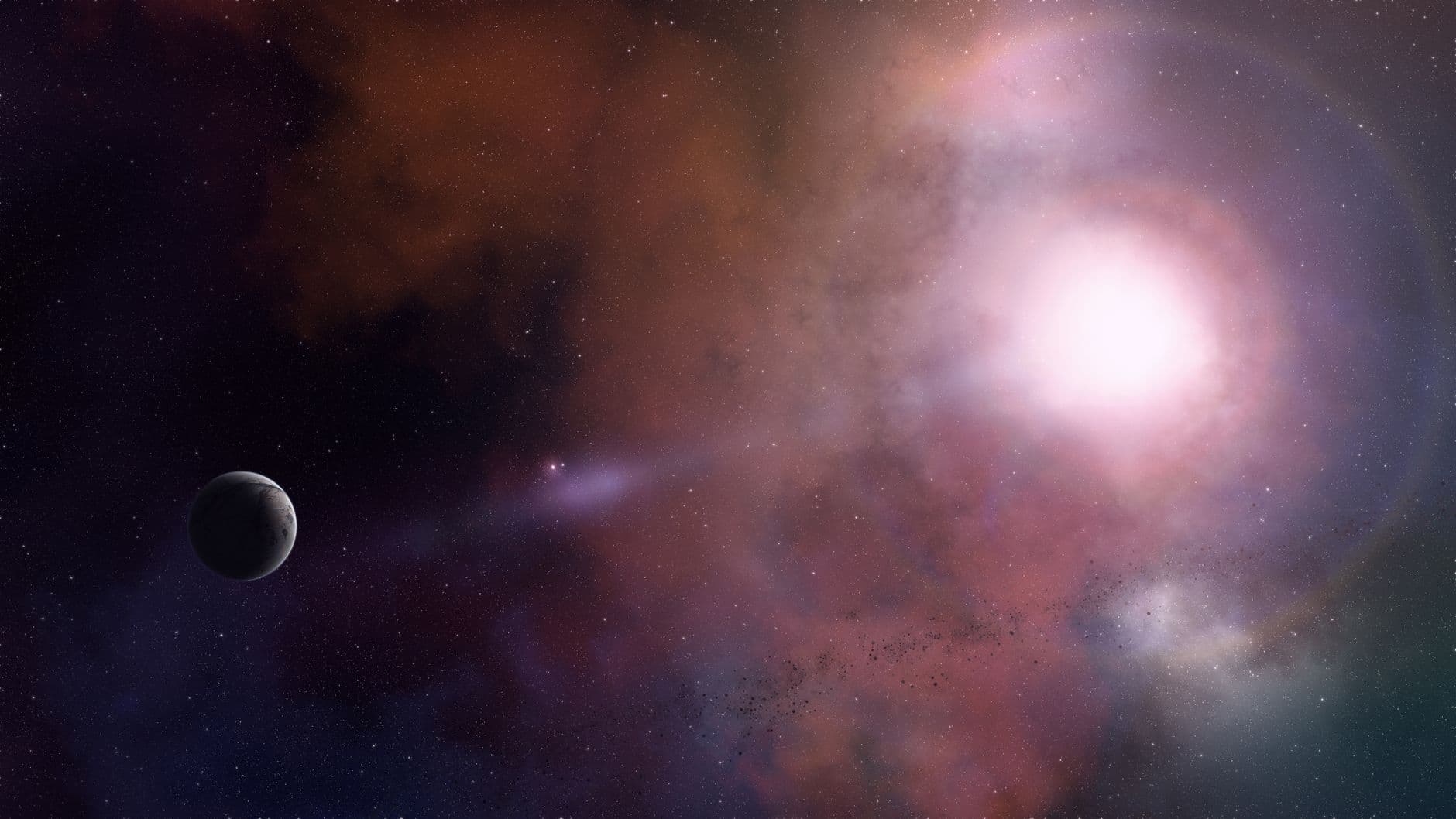
Neutron Stars: The Universe's Most Extreme Objects
A teaspoon of neutron star material would weigh about 6 billion tons—roughly the mass of Mount Everest squeezed into something the size of a sugar cube. These aren't theoretical constructs either. They're real, they're out there, and they're some of the most violent, chaotic objects in existence.
Neutron stars represent what happens when the universe decides to break the rules. When a massive star dies, it doesn't go gently into the night. Instead, it collapses catastrophically, crushing itself under its own gravity until something extraordinary emerges from the wreckage.
What Happens During Stellar Collapse
When a star with at least 20 times the Sun's mass reaches the end of its life, it runs out of nuclear fuel. The core can no longer support itself against gravity's relentless pull. Everything caves inward in a fraction of a second—a stellar implosion so violent it triggers a supernova explosion that briefly outshines entire galaxies.
What's left behind is something almost incomprehensible. The core compresses until electrons are forced into protons, creating neutrons and releasing ghostly neutrinos. Gravity keeps crushing everything down until you reach a state where matter itself behaves like nothing you've ever encountered.
A typical neutron star is about 20 kilometers across. Yet it contains more mass than our entire Sun. The density is so extreme that the strong nuclear force—the same force holding atomic nuclei together—becomes the primary force resisting further collapse.
Pulsars and Neutron Star Rotation
Here's where things get truly wild. When a massive star collapses, it spins faster and faster—the same physics that makes a figure skater spin quicker when they pull in their arms. Some neutron stars rotate hundreds of times per second.
These rapidly spinning neutron stars are called pulsars. As they spin, their powerful magnetic fields sweep beams of radiation across space. When those beams point toward Earth, we detect regular pulses of radio waves, X-rays, and gamma rays with the precision of atomic clocks.
Pulsars were so precise when first discovered in 1967 that astronomers initially thought they might be signals from alien civilizations. The regularity was almost too perfect to be natural. We now know better, but that initial confusion speaks to how strange these objects truly are.
The Physics of Extreme Dense Matter
Inside a neutron star, the laws of physics operate at extremes we can barely test in laboratories. Temperatures reach billions of degrees. Magnetic fields are trillions of times stronger than Earth's. Pressures are so intense that protons and neutrons transform into exotic forms of matter that don't exist anywhere else in the universe.
Scientists believe the core might contain quark matter—a bizarre state where quarks roam freely instead of being confined within neutrons and protons. We can't recreate these conditions on Earth, so neutron stars serve as natural laboratories for testing physics at its most extreme.
Some neutron stars aren't alone. Binary systems exist where a neutron star orbits a companion star, slowly pulling material from it. This creates accretion disks that heat up and blast X-rays across the cosmos. These cosmic vampires are among the brightest X-ray sources in the night sky.
Why Neutron Stars Matter to Us
Beyond the sheer spectacle, neutron stars teach us fundamental physics. They're cosmic laboratories where matter behaves in ways impossible to replicate on Earth. Every observation helps us understand gravity, nuclear physics, and the universe's ultimate building blocks.
In 2015, scientists detected gravitational waves from two colliding neutron stars—a discovery that won a Nobel Prize. These collisions create gold, platinum, and other heavy elements we find on Earth. Every precious metal in your jewelry was likely forged in events like this, billions of years ago.
Neutron stars remind us that the universe is far stranger and more violent than our everyday experience suggests. They're the ultimate survivors, the remnants of stellar catastrophe, and windows into physics at its most extreme.
Want to explore more about the cosmos's most extreme phenomena? Check out our space and astronomy section for deeper dives into pulsars, black holes, and the violent deaths of stars. You can also browse our daily feed for the latest discoveries in cosmic exploration or visit our main blog for more nature stories that will challenge everything you thought you knew about the universe.