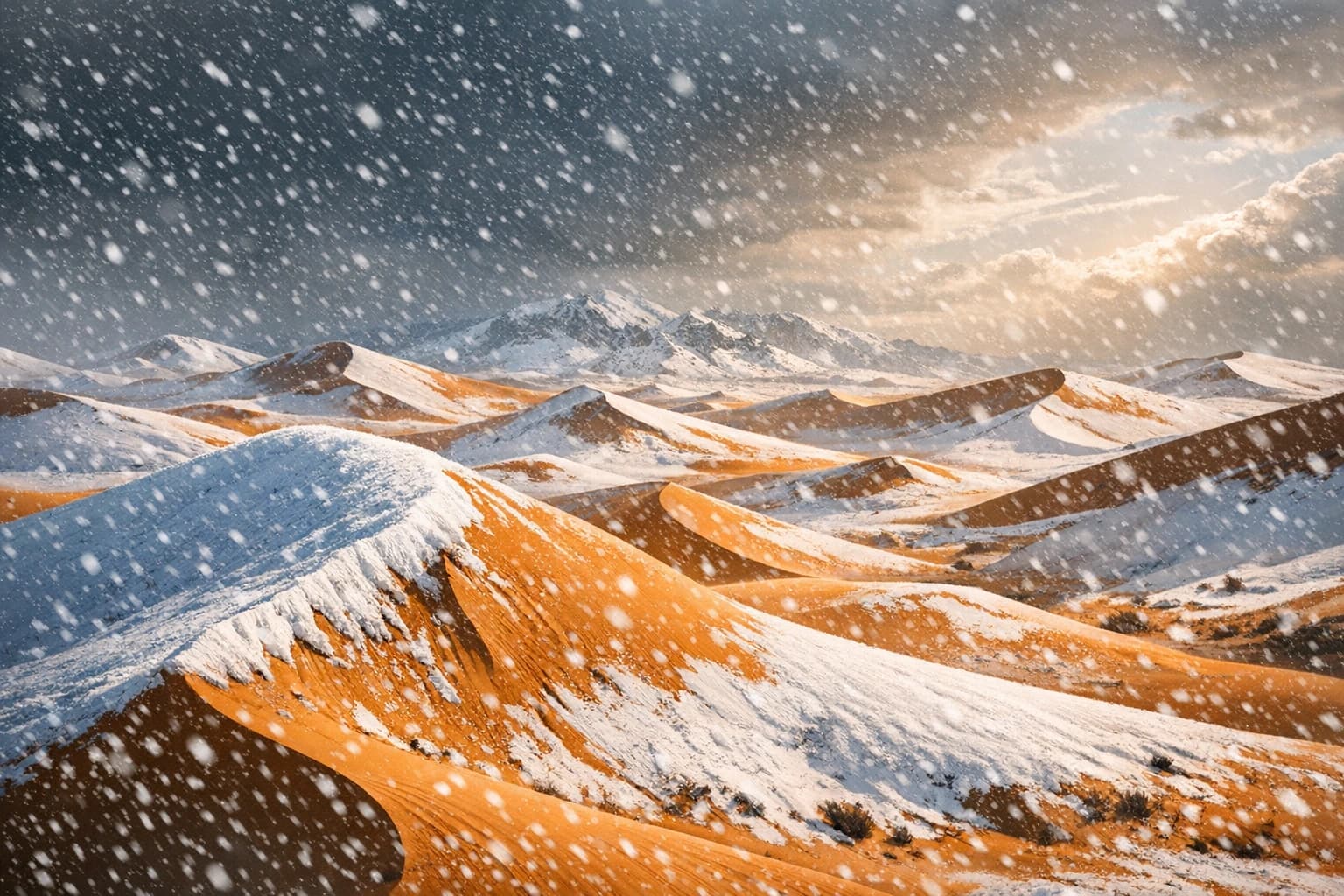
The Sahara Desert is often imagined as an endless ocean of heat. Vast dunes stretch toward the horizon, the air shimmers under an unforgiving sun, and temperatures rise so high that survival itself becomes a challenge. It is a place defined by extremes, where dryness and heat dominate every aspect of the environment. For many, it represents the very definition of a desert.
And yet, there are moments when this landscape transforms in a way that feels almost impossible. The same dunes that burn under the sun can, under the right conditions, be covered in snow.
At first glance, the idea seems contradictory. Snow belongs to mountains, forests, and polar regions, not to one of the hottest places on Earth. But nature is rarely as simple as it appears, and the Sahara holds secrets that challenge even our most basic assumptions about climate and geography.
To understand how snow can fall in such an extreme environment, it is necessary to look beyond the surface and explore the deeper forces that shape the desert.
The Geography of the World's Largest Hot Desert
The Sahara is not just hot. It is vast. Covering much of North Africa, it stretches across multiple countries and includes a wide range of landscapes, from sandy dunes to rocky plateaus and even mountain ranges. According to Britannica's overview of the Sahara Desert, its sheer geographic footprint plays a massive role in its unpredictable climate variations.
While daytime temperatures can soar to extreme levels, the desert also experiences dramatic shifts between day and night. Heat escapes quickly in dry environments, and without moisture or cloud cover to trap warmth, temperatures can drop rapidly after sunset. In some regions, especially at higher elevations, the air can become surprisingly cold.
The Science of Snowfall in the Sahara
One of the most important areas in this phenomenon is the region around the Atlas Mountains and parts of northern Algeria. These areas sit at higher altitudes, where temperatures are naturally lower.
During certain winter weather patterns, a high-pressure system over Europe forces cold air masses from the north to move south into North Africa, bringing with them the conditions needed for freezing weather. When this cold air meets rare moisture in the atmosphere, something extraordinary happens: snow begins to fall.
Ain Sefra: The Gateway to the Sahara
This is not a common event. In fact, it is rare enough that each occurrence attracts global attention. But it has been recorded multiple times in recent decades, with notable snowfall events occurring in places like Ain Sefra, an Algerian town often referred to as the “gateway to the Sahara.”
When snow falls in the desert, the transformation is almost surreal. The familiar colors of the Sahara, warm shades of orange and gold, become muted under a layer of white. The dunes, usually shaped by wind and heat, take on a softness that seems completely out of place.
The contrast is striking. Bright white snow rests on sand that, just days before, may have been too hot to touch. The landscape appears almost dreamlike, as if two completely different climates have merged into one.
These moments do not last long. The desert sun, even in winter, is powerful. Snow melts quickly, often disappearing within hours or days. But for a brief period, the Sahara becomes something entirely different, a place where heat and cold exist side side by side.
Why Desert Snowstorms Are So Rare
The science behind this phenomenon reveals just how dynamic Earth’s climate can be. Weather is not defined by a single factor but by the interaction of many elements, including:
Extreme barometric pressure shifts
Rapid temperature drops
Altitude and mountain geography
Sudden influxes of atmospheric moisture
In the case of the Sahara, snowfall requires a precise combination of conditions. Cold air must move far enough south, temperatures must drop below freezing, and there must be enough moisture in the atmosphere for precipitation to occur. Each of these factors is relatively uncommon in the desert, which is why snowfall remains such a rare event.
However, rarity does not mean impossibility.
Tracking Extreme Climate Events with Modern Technology
The Sahara is a reminder that even the most extreme environments are subject to change. It challenges the idea that deserts are always hot and unchanging, showing instead that they are part of a complex and interconnected global system.
In recent years, increased scientific observation and advanced satellite monitoring have made it easier to track these rare events. Space agencies like NASA's Earth Observatory frequently capture stunning satellite images of desert snow from space, allowing researchers to study the exact atmospheric conditions that lead to these events.
This research contributes to a deeper understanding of how weather systems move and interact across continents. It also helps scientists explore how changing global conditions and climate shifts might influence the frequency of such extreme desert weather events in the future.
Conclusion: Challenging Our Environmental Assumptions
There is a deeper lesson hidden within this phenomenon. It encourages a broader perspective on how we understand the world. Labels like “hot” and “cold,” “dry” and “wet,” are useful, but they do not capture the full complexity of nature.
The Sahara is indeed one of the hottest places on Earth. But it is not defined by heat alone. It is part of a system that includes extremes of many kinds, and under the right conditions, those extremes can overlap. Snow in the desert is not a contradiction; it is a reminder that the natural world does not always follow the patterns we expect.
Standing in the Sahara during one of these rare events would feel like witnessing something almost impossible. The silence of the desert, combined with the softness of snow underfoot, creates an atmosphere that is both familiar and entirely foreign.
It is in these moments that the true complexity of our planet becomes clear. The Sahara is a place of extremes, where the unexpected can happen, even if only for a short time. And perhaps that is what makes it so fascinating—because even in the hottest desert on Earth, winter can still find a way to appear.