The Forgotten Pyramid Capital of the World
For most people, the word “pyramids” immediately brings to mind a single place. Vast golden deserts, towering stone structures, and the unmistakable silhouette of the Great Pyramid rising against the horizon of Giza. Egypt has become almost synonymous with pyramids, so much so that it feels unquestionable that this is where most of them exist. Yet history tells a different story, one that quietly unfolds just to the south, in a land that rarely receives the same attention.
Sudan, not Egypt, holds the record for the greatest number of pyramids in the world. Scattered across its deserts are more than two hundred and fifty pyramids, many of them standing in remote silence, largely untouched by mass tourism. This fact alone feels surprising, almost contradictory to everything commonly believed. But as with many things in history, the truth is not always where the spotlight shines the brightest.
To understand how Sudan came to hold this remarkable distinction, it is necessary to look beyond Egypt and into the story of a powerful and often overlooked civilization that once thrived along the Nile.
The Rise of the Kingdom of Kush
The origins of Sudan’s pyramids are deeply connected to the ancient Kingdom of Kush, a civilization that flourished south of Egypt for centuries. While Egypt dominated the northern Nile, Kush grew into a formidable power in its own right, developing its own culture, traditions, and architectural identity. For long periods, the relationship between Egypt and Kush was complex, shifting between trade, conflict, and influence.
At times, Egypt exerted control over Kush, spreading its cultural and religious practices. At other times, Kush rose to dominance and even ruled Egypt itself. This reversal of power reached its peak during the period known as the Twenty-fifth Dynasty, when Kushite kings governed Egypt as pharaohs. These rulers did not simply imitate Egyptian traditions. They absorbed them, reshaped them, and ultimately carried them back to their own homeland.
It is within this exchange of influence that the story of Sudan’s pyramids begins.
Egyptian vs. Kushite Pyramids: What Is the Difference?
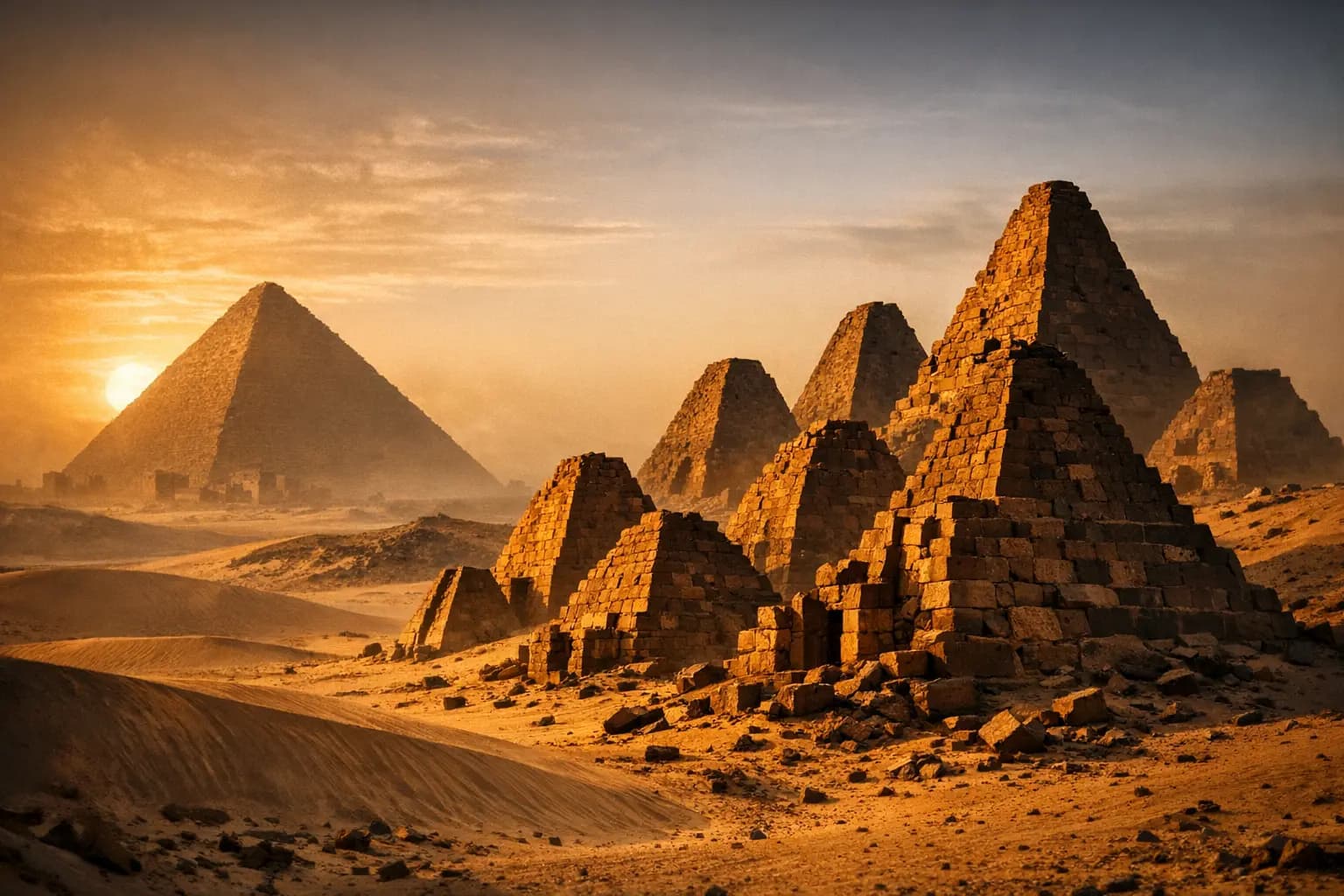
The Kushites adopted the concept of pyramid building from Egypt, but they did not replicate it exactly. Instead, they transformed it into something distinctly their own. While Egyptian pyramids are known for their massive scale and broad bases, Kushite pyramids are noticeably different in form. They are smaller, steeper, and more sharply angled, rising almost abruptly from the desert floor.
This difference is not simply aesthetic. It reflects a different approach to burial practices and architectural design. The pyramids in Sudan were primarily built as tombs for kings, queens, and other members of the elite. Beneath each structure lies a burial chamber, often accessed by a staircase descending deep into the ground. These chambers were richly decorated and filled with objects meant to accompany the deceased into the afterlife.
The Royal Cemeteries of Meroë, Nuri, and El-Kurru
Over time, the Kushites constructed pyramids in several key locations, most notably at sites such as Meroë, Nuri, and El-Kurru. Each of these locations served as a royal cemetery, gradually filling with pyramids as generations passed. The result is a landscape that feels almost surreal, with clusters of pyramids rising unexpectedly from the sand, far from the crowds that gather around Egypt’s more famous monuments.
What makes Sudan’s pyramids particularly remarkable is not only their number but also their density. In some areas, dozens of pyramids stand close together, creating a visual impression that is both striking and unfamiliar. Unlike the widely spaced pyramids of Giza, these structures form compact groups, almost like stone forests emerging from the desert.
Why Are Sudan’s Pyramids So Unknown?
Despite their historical importance, Sudan’s pyramids remain relatively unknown to much of the world. There are several reasons for this. Geography plays a significant role, as many of these sites are located in remote regions that are not easily accessible. Political instability in the region over the years has also limited tourism and international attention.
At the same time, Egypt’s pyramids have benefited from centuries of fascination, exploration, and promotion. From early European expeditions to modern tourism campaigns, Egypt has been positioned as the global symbol of ancient civilization. Sudan, by contrast, has remained largely in the background, its historical treasures quietly enduring without the same level of recognition.
Reclaiming a Forgotten African Narrative
Yet for those who study history more closely, the significance of Sudan’s pyramids becomes impossible to ignore. They represent not only the achievements of the Kushite civilization but also the broader story of cultural exchange along the Nile. The pyramids are evidence of how ideas can travel, evolve, and take on new forms in different contexts.
There is also a deeper narrative hidden within these structures, one that speaks to the shifting balance of power in the ancient world. The fact that Kushite rulers once governed Egypt challenges the common perception of a one-directional flow of influence. It reveals a more dynamic relationship, where power and culture moved back and forth between regions over time.
Archaeological discoveries continue to shed light on this history. Ongoing excavations at the Meroë Archaeological Sites have uncovered intricate carvings, inscriptions, and artifacts that provide insight into Kushite beliefs and daily life. These findings show that the civilization was not merely an extension of Egypt but a distinct culture with its own identity.
The pyramids themselves, though smaller than those of Egypt, are no less impressive in their craftsmanship. Their steep angles and clean lines create a sense of verticality that is striking against the flat desert landscape. In the early morning or late afternoon, when the sun casts long shadows across the sand, these structures take on an almost otherworldly appearance.
The Threat of Graverobbing and Destruction
However, Sudan’s pyramids have also faced challenges over the centuries. Many were damaged or partially destroyed, particularly during the nineteenth century when treasure hunters sought to extract valuables from the tombs. In a notorious historical event, Italian explorer Giuseppe Ferlini smashed the tops off dozens of Meroë pyramids in his search for hidden riches.
Despite this, a significant number of these structures still stand, preserving the legacy of a civilization that deserves far greater recognition.
Conclusion: Looking Beyond the Spotlight
In recent years, there has been a growing effort to bring attention to Sudan’s archaeological heritage. Scholars, historians, and cultural organizations have begun to highlight the importance of these sites, emphasizing their role in understanding the broader history of Africa and the ancient world. Slowly, awareness is increasing, and with it, a renewed appreciation for what Sudan has to offer.
What makes this story particularly fascinating is how it challenges assumptions. The idea that Egypt holds the record for pyramids feels so ingrained that it rarely comes into question. Yet the reality is more complex and, in many ways, more interesting. Sudan’s pyramids invite us to look beyond the familiar and explore a part of history that has remained in the shadows for too long.
They also remind us that history is not always defined by what is most visible or most widely known. Sometimes, the most remarkable stories are the ones that exist just outside the spotlight, waiting to be discovered by those willing to look a little closer.
Standing among the pyramids of Sudan, one would not find the crowds or the constant movement that characterizes Egypt’s famous sites. Instead, there is a sense of stillness, as if time itself has slowed. The desert stretches endlessly, and the pyramids rise quietly from the sand, bearing witness to centuries of history that have passed largely unnoticed.
It is in this silence that their true significance becomes clear. These structures are not simply remnants of the past. They are a testament to human creativity, resilience, and the enduring desire to leave something behind.
The story of Sudan’s pyramids is not just about numbers, although the fact that there are more of them than in Egypt is certainly striking. It is about rediscovering a forgotten chapter of history and recognizing the contributions of a civilization that played a far greater role than is often acknowledged.
In the end, the pyramids of Sudan do more than challenge a common misconception. They expand our understanding of the ancient world and remind us that history is far richer and more complex than it first appears.