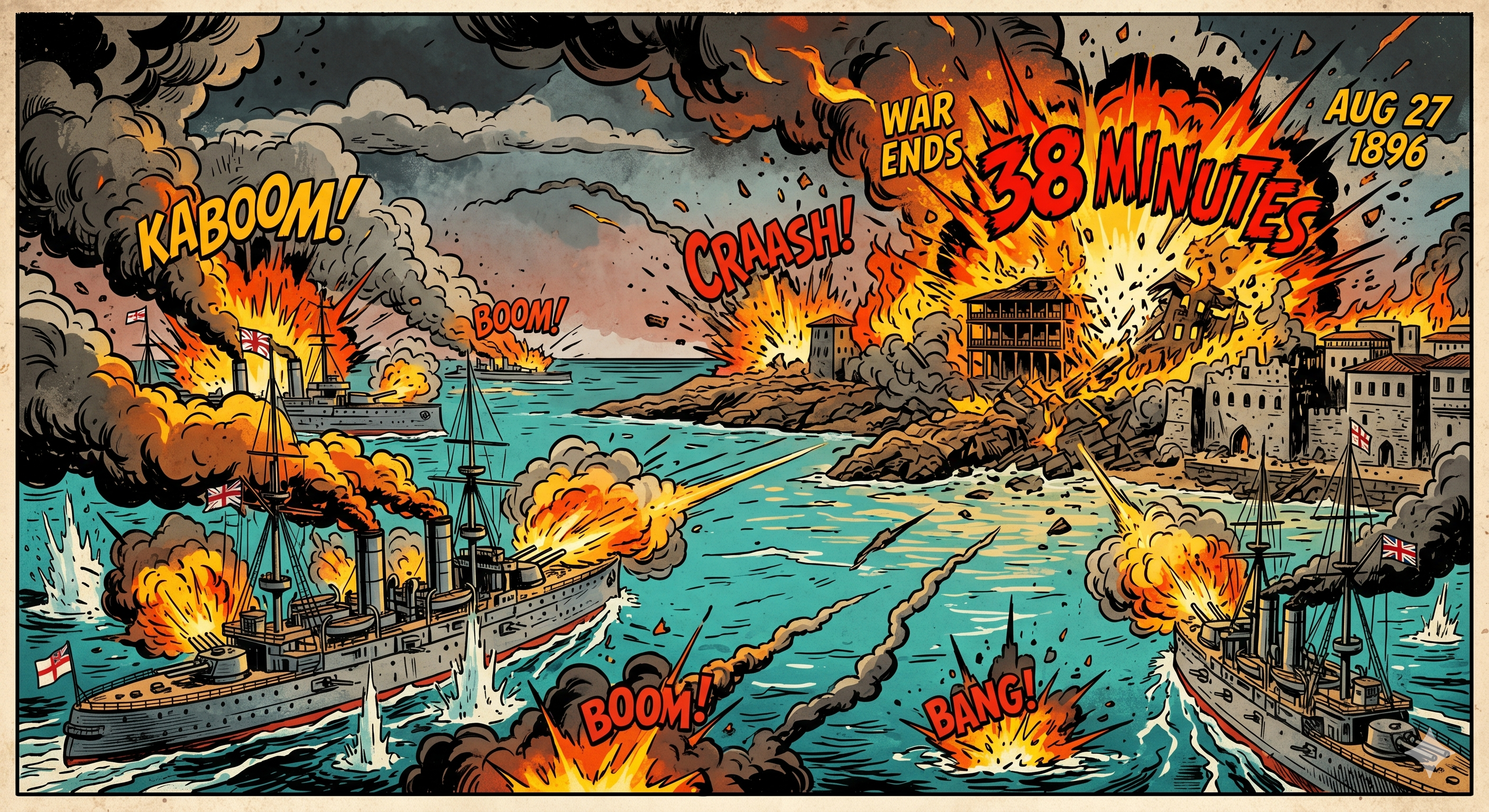
Introduction: a war that ended almost before it began
Wars are usually remembered for their length, their devastation, and the way they reshape nations over time. Some conflicts stretch across years, leaving behind deep scars that last for generations. Others burn intensely but briefly, leaving behind destruction that echoes far beyond their duration. Yet history holds a rare and astonishing exception, a war so short that it challenges our entire understanding of what war truly is.
In 1896, a conflict between the British Empire and the Sultanate of Zanzibar lasted only thirty-eight minutes. It remains the shortest war ever recorded. At first glance, it seems almost insignificant, more like an anecdote than a real historical event. But beneath its brevity lies a story of power, control, resistance, and the harsh realities of the colonial world.
To understand how such a war could happen, and why it ended so quickly, it is necessary to step back into a time when empires stretched across continents and decisions made in moments could determine the fate of entire nations.
The political stage in Zanzibar
By the late nineteenth century, Zanzibar had become one of the most important trading hubs along the East African coast. Its location made it a gateway between Africa and the wider world, linking trade routes that extended toward Arabia, India, and beyond. Ships arrived carrying goods and left with valuable cargo, making the island a center of wealth and influence.
Spices such as cloves brought immense prosperity, while ivory and other resources contributed to Zanzibar’s economic power. However, this prosperity also attracted the attention of foreign empires eager to expand their influence.
Although Zanzibar appeared to be an independent sultanate, it existed under strong British influence. Through treaties and political pressure, the British Empire had positioned itself as the ultimate authority behind the throne. The sultan ruled, but only within limits defined by British interests.
This arrangement created a fragile balance. As long as rulers cooperated, stability was maintained. But the system depended on obedience, and any challenge to that structure risked immediate consequences.
The sudden death of a sultan
On August 25, 1896, Sultan Hamad bin Thuwaini died unexpectedly. His death created a sudden power vacuum, and in such moments, political ambition often moves faster than diplomacy.
Within hours, Khalid bin Barghash, a determined and ambitious member of the royal family, acted decisively. Without waiting for British approval, he declared himself the new sultan and occupied the palace.
His decision was not made in ignorance. Khalid understood the political situation, and he knew that his claim would be rejected by the British. Yet he chose to act anyway, perhaps believing that speed and determination might secure his position before foreign intervention could take place.
Instead, his actions triggered a crisis.
An ultimatum and a final warning
The British response came swiftly. They refused to recognize Khalid as the legitimate ruler and demanded that he step down immediately.
A formal ultimatum was delivered. Khalid was given until nine o’clock in the morning on August 27 to leave the palace and relinquish control. The message was clear and left no room for negotiation. If he refused, military action would follow.
As the deadline approached, tension spread across Zanzibar. British warships moved into position along the coastline, their presence both a warning and a promise. Diplomats hoped that Khalid might reconsider, that the threat alone would be enough to avoid conflict.
But Khalid did not yield.
Instead, he chose to resist. He gathered thousands of supporters, positioned artillery around the palace, and prepared for confrontation. The decision sealed his fate, although its consequences would unfold far more quickly than anyone expected.
The beginning of the shortest war
On the morning of August 27, the final moments before the deadline passed in silence.
Then, at exactly nine o’clock, the ultimatum expired.
Within moments, British naval forces opened fire. The sound of artillery shattered the calm of the morning as shells struck the palace with overwhelming force. Smoke and debris filled the air as the bombardment began.
The contrast in military strength was immediately clear. British warships, equipped with modern weapons, dominated the battlefield. Khalid’s forces, though numerous, lacked the firepower and organization necessary to mount an effective defense.
The palace attempted to return fire, but its efforts were quickly overwhelmed. The British bombardment was relentless, precise, and devastating.
Thirty-eight minutes that changed everything
The destruction unfolded with astonishing speed.
Walls collapsed under the impact of repeated shelling. Fires broke out and spread rapidly through the structure. The palace, once a symbol of authority and power, was reduced to chaos within minutes.
Khalid’s forces began to falter almost immediately. Their resistance, though determined, could not withstand the scale of the attack. One by one, their defenses failed.
By approximately nine thirty-eight in the morning, the conflict was over.
Thirty-eight minutes had passed since the first shot was fired.
In that short span of time, hundreds of Zanzibari soldiers and civilians were killed or injured. The British, by contrast, suffered minimal losses, highlighting the overwhelming imbalance between the two sides.
What had begun as a defiant stand ended as a decisive and rapid defeat.
The escape of a defeated ruler
As the palace fell and defeat became inevitable, Khalid fled. Rather than surrender to British forces, he sought refuge in the German consulate nearby.
Germany, another imperial power with interests in the region, offered him protection. This act was not purely humanitarian but also political, reflecting the complex rivalries between European nations during the colonial era.
From the consulate, Khalid was eventually transported to German-controlled territory, escaping capture and avoiding immediate punishment. His brief reign had ended almost as quickly as it had begun.
A new ruler and a restored order
With Khalid removed from power, the British acted quickly to restore control.
They installed Hamoud bin Mohammed as the new sultan, a ruler who was willing to cooperate fully with British authority. This ensured that Zanzibar would remain aligned with British interests and that similar challenges would be discouraged in the future.
The rapid appointment of a new leader reinforced the message that the events of that morning were not merely a military action but a demonstration of political control.
Why the war ended so quickly
The extraordinary brevity of the conflict was not accidental. It was the result of several decisive factors working together.
The most important was the overwhelming military superiority of the British. Their ships and artillery far exceeded anything available to Khalid’s forces, ensuring that any confrontation would be one-sided.
Preparation also played a crucial role. British forces were already positioned and ready to act the moment the ultimatum expired. There was no delay, no hesitation, and no opportunity for Khalid to adjust his strategy.
Additionally, Khalid’s resistance, while bold, lacked the coordination and resources needed to sustain a prolonged conflict. Once the bombardment began, defeat became inevitable.
Finally, the British objective was not to engage in a long war. Their goal was to remove Khalid from power quickly and decisively, and the speed of the conflict reflects how effectively that objective was achieved.
The broader meaning behind the conflict
Although the Anglo-Zanzibar War is often remembered for its duration, its true significance lies in what it represents.
It illustrates the realities of colonial power, where decisions made by local rulers could be overridden by distant empires. Zanzibar’s lack of autonomy in choosing its own leader highlights the imbalance that defined much of the world at the time.
The war also demonstrates how technological and strategic advantages can determine the outcome of a conflict before it even begins. In many ways, the result was decided long before the first shot was fired.
Conclusion: a moment that echoes through history
The story of the shortest war in history is not merely a curiosity. It is a reminder that history does not always unfold slowly. Sometimes, events of great importance happen in the span of minutes.
In just thirty-eight minutes, a ruler lost his throne, a palace was destroyed, and the future of a nation was reshaped. The speed of the conflict does not diminish its impact. If anything, it makes it even more striking.
More than a century later, the story continues to fascinate because it challenges our expectations and reveals how fragile power can be when faced with overwhelming force.
Sometimes, history does not take years to change.
Sometimes, it changes in less than an hour.