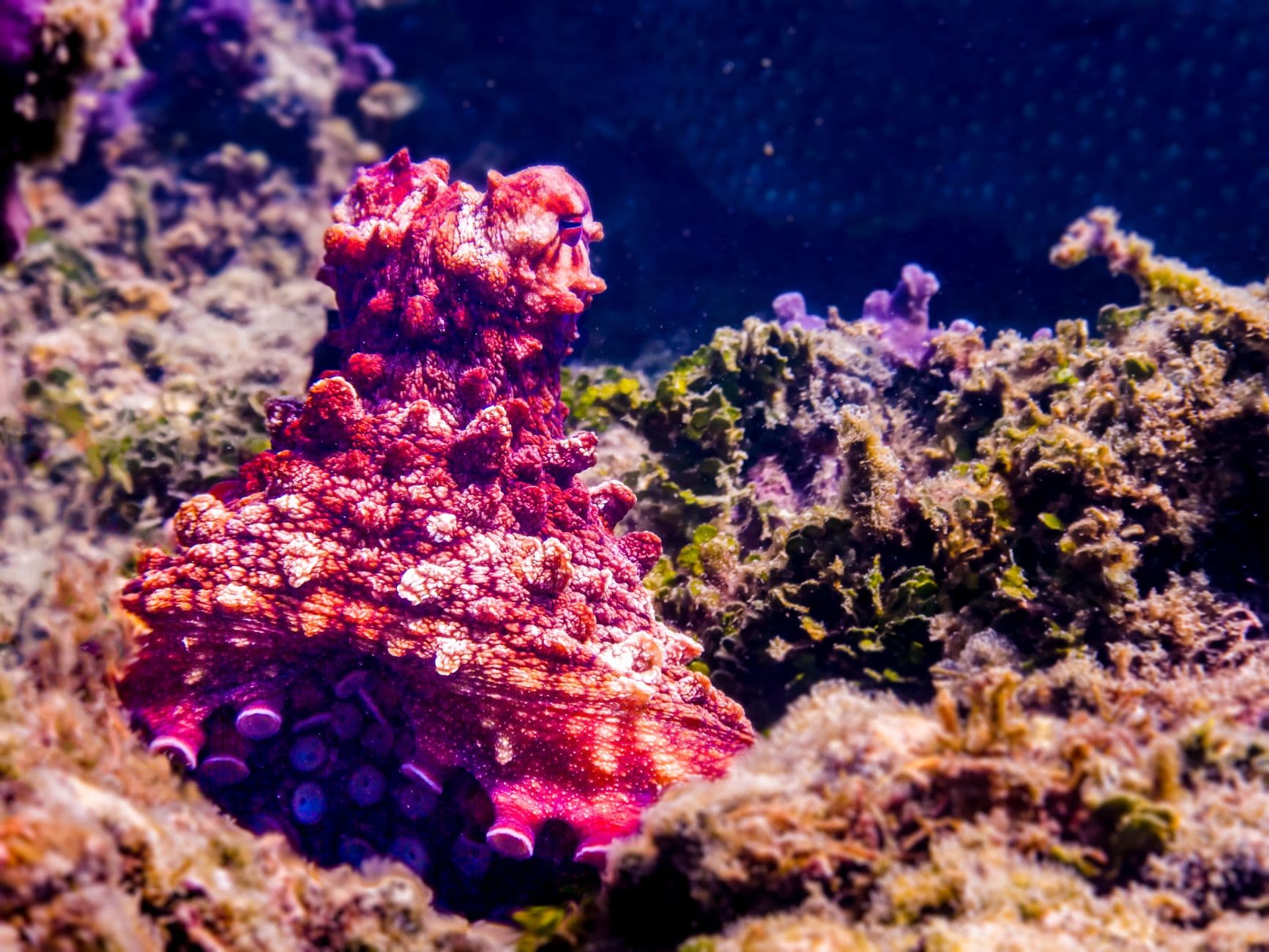
How Octopuses Edit Their Own DNA While Alive
Octopuses can rewrite their own genetic code in real-time without waiting for evolution to do the work. This isn't science fiction—it's happening in oceans right now, and it fundamentally changes how we understand life itself.
Most animals are stuck with the DNA they inherit from their parents. Mutations happen, sure, but they take generations to become useful. Octopuses threw that rulebook in the trash.
The RNA Editing Mechanism That Changes Everything
Inside octopus cells, something wild occurs: they edit RNA messages before those messages get translated into proteins. RNA editing in animals happens when special enzymes called ADARs swap out one genetic letter for another, changing the protein that gets made without touching the original DNA blueprint.
Think of it like this. Your DNA is the master copy of a recipe, locked in a vault. RNA is the photocopy you actually work from in the kitchen. Octopuses can scribble changes on that photocopy before they start cooking.
While most animals barely use this trick, octopuses do it constantly. Scientists have found that roughly 60% of their RNA undergoes editing. For comparison, humans edit maybe 1%.
Survival in the Extreme: How Octopuses Adapt to Temperature
Temperature changes destroy the delicate machinery inside cells. Proteins lose their shape, chemical reactions slow down, and the organism dies. Octopuses living in different ocean zones face wildly different temperatures—sometimes changing by 20 degrees Celsius between hunting depths.
Here's the genius part: when an octopus moves to colder water, it edits the RNA that builds its ion channels—the proteins that control electricity flowing through nerve cells. These edited versions work perfectly in cold water when the original versions would jam up.
This happens in hours or days, not generations. A Nature study showed that when octopuses experience temperature stress, their cells immediately ramp up RNA editing to compensate.
Predators and prey don't wait for evolution. Neither does the octopus.
Invertebrate Intelligence Meets Molecular Biology
Octopuses already blow our minds with problem-solving abilities and tool use—skills we typically reserve for vertebrates. Now we know their brains can rewrite their own genetic instructions in response to danger.
Each of their eight arms contains roughly two-thirds of their neurons. Those arms think semi-independently, solving puzzles and wrestling with prey while the central brain handles strategy. Combined with DNA editing, this creates an organism that adapts faster than almost anything else.
Scientists at the University of Chicago discovered that octopuses even edit RNA in their neurons specifically—the cells most sensitive to temperature changes. It's targeted adaptation at the molecular level.
What This Means for Evolution and Survival
Traditional evolution takes time. Random mutations arise, the useful ones spread through populations, and species gradually change. RNA editing flips the switch on survival adaptation from generational timescales to immediate response.
This explains why octopuses thrive in nearly every ocean habitat despite being relatively young as a species. While other animals needed millions of years to adapt to different temperatures and pressures, octopuses edited their way there in real-time.
Climate change is happening faster than most species can evolve. But for octopuses, rapid environmental shifts trigger rapid molecular responses. It's like having a cheat code built into their cells.
Researchers at Smithsonian Ocean Portal believe understanding octopus RNA editing could eventually help us develop treatments for human diseases caused by protein malfunction.
The octopus proves that life finds ways to rewrite its own rules when survival demands it. Nature isn't as locked into its patterns as we assumed.
Want to explore more mind-bending discoveries about how animals survive in extreme conditions? Check out our DNA and Biology category for stories that challenge everything you thought you knew. Or browse our daily feed for the latest nature breakthroughs.